The Extinction Enigma
The marsupial lion is just one of numerous big-bodied animals, or
"megafauna," that went extinct in Australia between about 50,000 and
45,000 years ago. Who or what killed them off, and why over such a short
period? Gifford Miller, a professor of geological sciences at the
University of Colorado at Boulder, has been studying this question for
years. In Miller's opinion, humans, who are thought to have arrived in
Australia not long before the megafauna went extinct, had something to
do with it, though no one has yet been able to conclusively show how—or,
for that matter, to rule out climate change or other possible causes.
Here, Miller describes what role human-started fires might have played,
what he'd ideally like to find to help solve the mystery, and what
lessons the mass extinction has for us today.

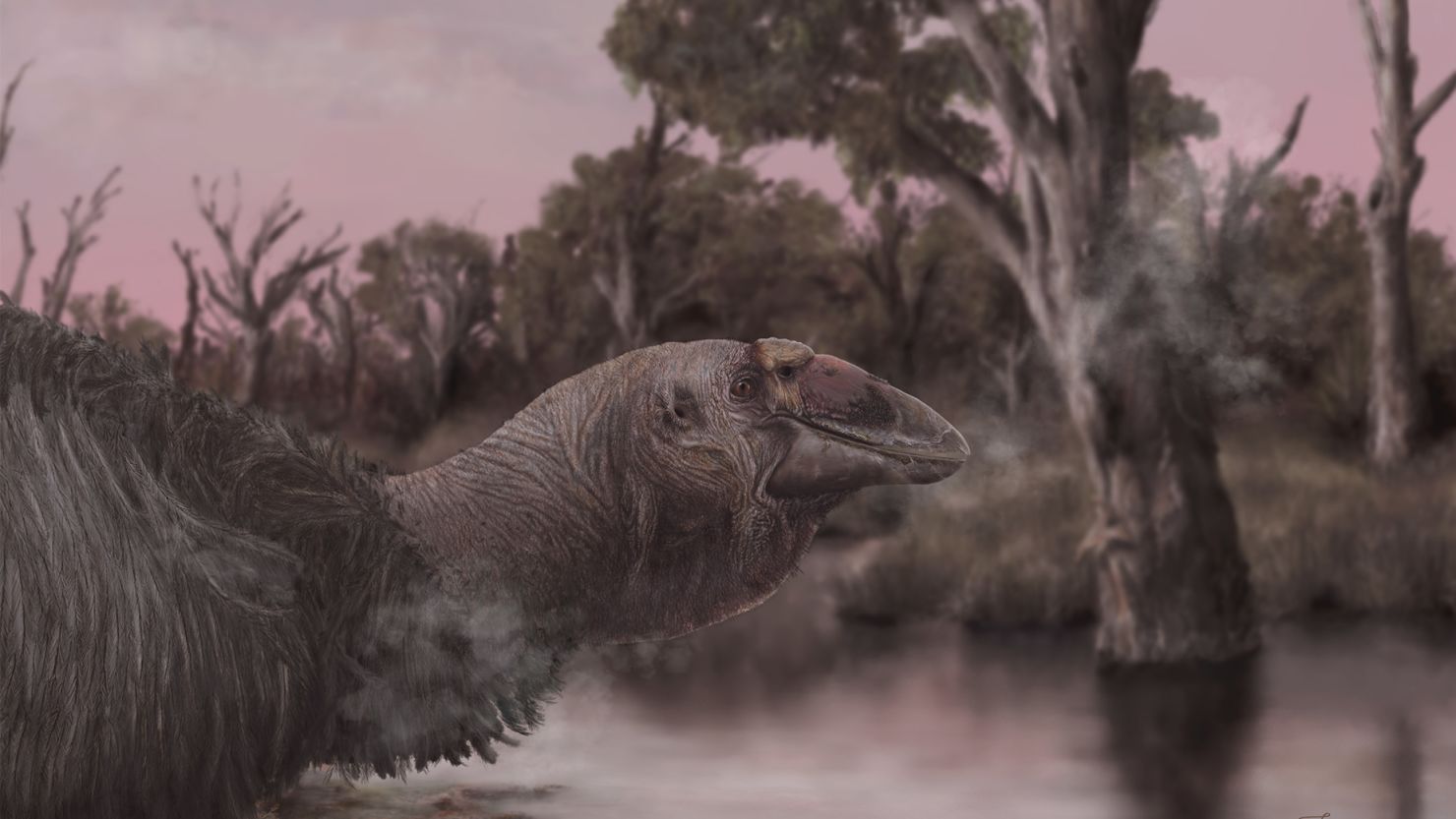
Two of Australia's long-vanished big beasts, the Komodo dragon-like
Megalania and the giant flightless bird
Genyornis newtoni. Illustration by Peter Trusler for
Wildlife of Gondwana.
Enlarge Courtesy Peter Trusler
CLIMATE CONUNDRUM
NOVA: So Australia had some pretty unusual animals when people first arrived, didn't it?
Gifford Miller: It's almost beyond
comprehension what some of these animals were like. There was a very
large, almost hippopotamus-sized, wombat-looking thing. It was the
largest marsupial that's ever lived. There were kangaroo-like animals
that, instead of being grazers, had arms that went up over their heads
and could pull down branches and eat leaves off of trees. There were
specialized animals for getting insects out of trees.
And then there were top-level carnivores that used those large animals as prey, such as
Thylacoleo,
the marsupial lion. It's often called the "drop cat," because its feet
are set up in a way that says it simply can't run, and the best
reconstructions are that this animal would sit up in a tree and wait for
its prey to come around, then leap out of the tree and pounce on its
prey.
Thylacoleo is just one of a whole
range of animals for which there are simply no modern representatives
left. It's a marsupial lineage, which is a different kind of mammal than
the placentals that are the dominant animals everywhere else.
How did Australia come to be marsupial heaven, anyway?
Well, Australia has a unique history: when it became isolated from the
rest of the world, the only mammalian group that got on board the
continent was the marsupials. They came out of South America and
migrated across Antarctica and onto Australia, which were all connected
then in the supercontinent Gondwana. As Gondwana broke apart, Australia
became detached and drifted in isolation over the ocean with only these
marsupial lineages on board. Evolution took its course, and over the
next 50 or 60 million years Australia evolved this whole array of
animals with no relatives anywhere else on the planet.

The marsupial lion,
Thylacoleo carnifex, has no living relatives. This specimen perished deep in an Australian cave over 500,000 years ago.
Enlarge © NOVA/WGBH Educational Foundation
And over that time the climate changed a lot, right?
Yes, when Australia broke off from Antarctica maybe 50 or 60 million
years ago, it was at a high southern latitude, where conditions were
relatively moist and cool. It had forest over the whole country, so we
had a really damp, cool, forested continent. Then it slowly drifted
north towards Asia, and in that process, it moved from those temperate
latitudes to the subtropical high-pressure zone, where the continent
became both warmer and drier. Consequently, the interior of the
continent in particular dried out. And the fossil record shows the
vegetation and the fauna adapting to those much more arid conditions.
Superimposed on the long-term shift from that a cool, moist climate
into subtropical aridity, the world entered an ice age about two million
years ago with glacial/interglacial cycles. Consequently, the last two
million years of that 50 million-year journey was a period of
high-amplitude climate change, from relatively warm, wet climates to
much drier and colder climates, back and forth repeatedly. And these
transitions occurred rapidly, many times over a few hundred to a few
thousand years. This would have been a very different kind of climate
stressor from the more gradual shift towards aridity.
There's no clear evidence that the ice-age cycles themselves led to any of the big extinctions.
But the animals got bigger. Isn't that strange?
It's almost counterintuitive. You might think that big animals would
have a hard time surviving on a more impoverished diet. But it actually
gives them a certain amount of resiliency, the ability to go through
periods of famine if they have to, because they have some body reserves
and the ability to eat a large amount of relatively low-nutrient food.

Recent discoveries in Australian caves, like the one explored in
NOVA's "Bone Diggers" (seen here), have allowed researchers to track how
the continent's big-bodied animals responded to climate changes.
Enlarge © NOVA/WGBH Educational Foundation
To what degree could these more intense climate changes have brought about the extinctions?
Well, it's really only the recent studies that have come out of cave
deposits that have time series long enough to be able to actually track
how the animals responded to the high-amplitude ice-age cycles. And
those studies clearly show that the assemblages of animals do
change—that is, certain animals move out when it gets dry, and when it
gets wet again, they come back. But within that we don't see any major
extinctions. Indeed, there's no clear evidence that the ice-age cycles
themselves led to any of the big extinctions.
So is climate change as the sole cause of the extinctions still a viable argument?
We are now to the point in Australia where there is not a tenable
climate argument that can explain the extinctions. We have enough
evidence, especially from new studies over the last decade, that has
simply, case by case, removed the climate argument as a viable
explanation.
That really pushes the question, then, to ask instead, well, if not
climate, then what else could it be? And the only real case out there is
that there's a human role. The real question now is, what is it that
humans might have done that would have resulted in the extinction? Is it
overhunting? Is it landscape modification? Did they bring in diseases?
Did they hunt mostly juveniles, which eventually led to species
extinction through attrition? Was it a long, slow extinction, or was it
something that happened in a much shorter period of time?
That's where much of the research right now will be directed, I think,
to ask how can we test between these various hypotheses of how human
activity might have impacted a continent, and to see whether we can't
steadily make some progress in that area.
The core question is, "Had humans never colonized Australia, would most
of the megafauna still be present on the continent?" I think the
consensus response to that question is "Probably, yes." Was climate a
contributing factor? Maybe. Animals are always stressed by temperature
extremes and moisture stress as well as from predation and competition
and a variety of other factors. But as far back as we can see, the
megafauna adjusted to these stressors without extinction. Only when
humans are added to the equation do we see the large extinction occur.

Gifford Miller believes fires set by humans long ago may have
irrevocably changed floral habitats in Australia, with
species-threatening effects on wildlife.
Enlarge istockphoto.com/© Simon Owler
A BURNING QUESTION
You've argued that humans' use of fire may have contributed to the extinctions on Australia. How so exactly?
When humans colonized Australia, we know they had fire on demand—we've
had that for maybe a half a million years—and at least in Australia,
humans burn for a whole range of reasons. They burn to clear the land so
that they can move across it. They hunt along the fire front. They
signal distant bands. Fire promotes the growth of beneficial plants that
sprout after burning. So there are many reasons why humans might be
burning the landscape in a way that they thought would have a positive
impact.
The Australian landscape is unique in that it has extremely low
nutrients in the soils, because it's a very ancient, flat landscape, and
most of the nutrients have already been removed from the soil. So it
has a high sensitivity to burning having a big impact. One of the
possibilities is that the cumulative effect of localized burning by
small bands of people in a patchwork fashion may have converted an
ecosystem that had a fairly highly productive set of plants into a much
less productive, fire-adapted landscape, such as we see today.
You wouldn't want to share your camp with a 25-foot-long carnivorous lizard.
Might the ecosystem have collapsed under such pressure?
Yes, if the landscape itself has a sensitivity to burning, then a
change in the fire regime might lead to an ecosystem collapse. Now,
Australia has always burnt. It has a high incidence of lightning
strikes, and almost all ecosystems there are adapted to burning. Some of
them, in fact, are extreme fire promoters, where the only way their
seeds can germinate is through fire. So you can't imagine that when
people first set fire to Australia that it had never seen fire before.
That's certainly not the case.
What humans can do, though, is they can burn at a different time of
year than the natural fire regime, and they can burn at a different fire
frequency. That is, they can start fires with a smaller fuel load than
would be required for lightning-strike fires. There are many ecosystems
where you can demonstrate that they are quite comfortable being burnt
once every 20 years, every 50 years, and recovering with no problem. But
if they're burnt back to back two or three years apart, that's more
than they can withstand, and those ecosystems die.

When the megafauna roamed Australia, the soils and plants were of
higher quality than they are today. Here, the paleontological team in
"Bone Diggers" descends into the cavern where the remains of numerous
extinct species were found.
Enlarge © NOVA/WGBH Educational Foundation
With disastrous results for the megafauna presumably.
Right. Clearly the animals depend on a minimum volume of nutritious
food to sustain them. The current vegetation across much of the arid and
semi-arid zone consists of almost unpalatable desert scrub, so there's
very little food value out there now. We know these big animals were
living out there in the past, and they certainly weren't eating what's
growing there now. We hypothesize that there must have been a much
different ecosystem that included nutritious grasses, which don't exist
there today, as well as some interspersed woodland leafy plants that
would have had sufficient nutrition to sustain these large animals.
Studies from my research group demonstrate that prior to human
colonization, large animals in the interior of the continent were eating
just such a mixture—feasting on nutritious grasses in years with good
rains, and depending on trees and shrubs in drier years. After 45,000
years ago, those nutritious grasses were nearly gone, and those animals
that hadn't gone extinct were restricted to dominantly tree and shrub
dietary sources.
Those ecosystems that flourished before humans arrived may have been
susceptible to a changed fire regime, in which case the sustained
burning patterns practiced by modern humans could have altered that
woodland grassy ecosystem to the present desert scrub. The large animals
simply would not have had sufficient food resources to sustain
themselves.
A HAND IN IT?
Could people have deliberately wiped them out?
Well, when humans first colonize a new landscape, they have to look
after their basic needs. They have to feed and protect their families,
and they have to stay warm and have shelter. So what's the footprint of a
successful human colonization? My general sense is that there's
certainly no deliberate attempt to try to remove a large segment of the
fauna, although you wouldn't want to share your camp with a 25-foot-long
carnivorous lizard or a large cat-like creature that might drop on you
from an overhanging branch.
You could imagine that people would want to protect themselves by
removing the big predators, but in terms of the much more abundant large
herbivores, which are a stable food source, it's unlikely that they're
deliberately trying to exterminate those. The lesson we might draw is
that modifications to make landscapes more suitable to our lifestyle, or
to give ourselves shelter, may inadvertently lead to the extinction of
what had been a major food source—these large marsupials that could have
been a nice meal for a band of humans.

Paleontologist John Long, leader of the Nullarbor cave expedition, holds the skull of the well-preserved marsupial lion.
Enlarge © NOVA/WGBH Educational Foundation
How might humans have affected top predators like Thylacoleo?
One tries to imagine what it would have been like to be the first
humans in Australia and to see not only these large animals that you
could eat, but also these large animals that might eat you. The question
then is, why didn't the
Thylacoleo win? Why didn't these giant lizards that are 25 feet long win?
The reality is that humans don't really have to hunt these big animals
to lead to their extinction. All they have to do is reduce the prey, the
large browsers and grazers on which the big carnivores depend.
Carnivores are very sensitive to prey abundance. If humans reduce the
number of potential prey below a threshold, then large predators like
Thylacoleo and the giant lizard
Megalania will likely starve to death.
NEW FINDINGS
What light do the finds from the Nullarbor caves [as shown in "Bone Diggers"] shed on the extinction question?
The Nullarbor caves, besides offering this beautiful array of
well-preserved fossils that are themselves interesting from the simple
curiosity standpoint, also provide the first look back in time at how
these big marsupials adapted to an arid environment. The Nullarbor is an
arid zone—there's not much vegetation there.
The Australian story says we should proceed with caution.
It's long been thought that the big marsupials weren't well-adapted to
extreme aridity, because they originated in a moist climate regime. As
the continent moved farther into the zone of aridity, and especially
with ice-age cycles of extreme aridity, this would have stressed them,
assuming they were not well-adapted to such climate extremes. In
contrast to this paradigm is the new record from the Nullarbor caves,
which goes back almost a million years and shows that these animals were
quite comfortable living in an arid zone during times of fluctuating
climates. They were apparently already well-adapted to the changed
moisture regime.
One of the most exciting additional aspects of the Nullarbor caves
study is that the research team was also able to reconstruct what the
climate was like at the time the large animals were living there. So we
know, independently of the fauna, something about the climate. Their
results tell us that the climate then was much like today: it was an
arid climate, and for a million years these animals were living
successfully in the arid zone. So that eliminates, really, the argument
that aridity was a major stressor on them, because they were living
there without significant extinctions for a million years.

Fragile monument to another time, this fossil bird is just one of
numerous extraordinary discoveries made within the Nullarbor cave.
Enlarge © NOVA/WGBH Educational Foundation
The other thing that's so important from this find, is that it tells
us—independently, now, from the climate—what the vegetation was like. So
we have three pieces: we know what animals were living there, we know
what the rainfall was, and we know the vegetation. The rainfall was like
today, but the vegetation was completely different, much more diverse,
with many more palatable elements in the ecosystem. So we have evidence
here, quite independent of any other evidence from Australia, that says
large marsupials were well-adapted to the arid zone but lived under a
very different vegetation assemblage than at present.
That, then, adds a very important piece to our question, "How might
humans have impacted large animals across Australia?" Human activity may
have altered ecosystems so that the vegetation present today is
fundamentally different from the vegetation of the past, despite similar
rainfall. The Nullarbor cave evidence tells us that in the past there
was an arid climate, very diverse vegetation, and large marsupials,
whereas the present day has the same climate but impoverished vegetation
and few large marsupials.
What would you ideally like to find to help solve this mystery?
What one would like to find is a continuous series of fauna right
through the extinction event. Possibly there is a pitfall cave somewhere
whose accumulation spans the extinction window. That would allow us to
better evaluate both the rate of extinction and whether extinction and
ecosystem change are coincident in time or not; this would be stunning
information. Somewhere out there, I expect that cave will eventually be
found. It would help us understand whether all the species that make up
the megafauna persist right up to the extinction window and then are
gone, or whether some of those elements fall out a little bit earlier.
It's a rare event, to get the preservation of one of these big
marsupials. So we are limited by our sample size, but by finding more of
these pristine caves, we should be able to flesh out that part of the
story.

"There is some sort of a threshold that was exceeded, beyond which
these big animals simply couldn't survive," says Gifford Miller, who
warns that humans could force animals today beyond similar thresholds.
Enlarge Courtesy Gifford Miller
In closing, what lessons do you take from these mass extinctions for us today?
Well, one of the lessons from the Australian story, I think, is a
two-fold one about life. One is, there's tremendous resiliency—flora and
fauna are able to find ways to adapt to big climate changes. But two,
there are thresholds, that despite having survived major climate
changes, ice-age cycles, with everybody adjusting and surviving, at some
point, extinction claimed the large marsupials (and many smaller ones).
It doesn't actually matter, for this lesson, what the cause was. There
is some sort of a threshold that was exceeded, beyond which these big
animals simply couldn't survive.
You can shift that lesson to the modern world. We're modifying
landscapes at unprecedented rates. The interconnections between all
these life activities are tremendously complex, and we don't really
understand them completely. So the Australian story says we should
proceed with caution, because despite life's tremendous resiliency,
there are thresholds in the system that when crossed yield distinctly
non-linear results, where changes take place suddenly that would not
have been anticipated by looking at what went on in the past.
Interview conducted on March 16, 2007 by Betsey Arledge, producer for NOVA of "Bone
Diggers," and edited by Peter Tyson, editor in chief of NOVA online
Fonte: http://www.pbs.org/wgbh/nova/evolution/extinction-enigma.html