Mostrando postagens com marcador Neanderthal. Mostrar todas as postagens

segunda-feira, 23 de dezembro de 2024

Translator


10 descobertas fascinantes sobre os Neandertais em 2024, de 'Thorin', o último Neandertal, a uma antiga fábrica de cola

(Crédito da imagem: Fabio Fogliazza)

As pessoas são fascinadas pelos Neandertais desde que descobrimos os seus ossos numa caverna alemã em meados do século XIX. Seus corpos atarracados e cabeças enormes nos dão um vislumbre do caminho evolutivo que poderíamos ter percorrido. Embora a investigação do ADN tenha mostrado que todas as populações humanas modernas têm um pouco de Neandertal, ainda vemos os nossos primos Neandertais como a linhagem das ovelhas negras do género Homo .

Aqui estão 10 coisas que aprendemos sobre nossos parentes mais próximos – e, por extensão, sobre nós mesmos – este ano.

Relacionado: O último dia de Lucy: o que o icônico fóssil revela sobre as últimas horas de nosso ancestral

1. Os neandertais tinham um grande senso de moda.

Os neandertais viviam na Europa, por isso tinham de proteger os seus corpos contra queimaduras de frio e outros problemas relacionados com o frio. Embora nenhuma roupa congelada de homem das cavernas tenha sido descoberta, os arqueólogos acreditam que os neandertais usavam roupas para ajudar a manter a temperatura corporal central.

Evidências circunstanciais de roupas de Neandertal incluem uma ferramenta de pedra com resíduos de raspagem de pele, furadores de osso pontiagudos usados ​​para fazer buracos em peles e um pedaço de corda torcida, possivelmente de sapatos ou tecido.

O tipo de roupa que os Neandertais usavam ainda está sendo debatido, mas provavelmente era mais elaborado do que uma tanga. Se os neandertais usavam parkas, calças e botas, provavelmente foram os primeiros fashionistas, disseram os pesquisadores à WordsSideKick.com.

2. Os Neandertais cuidavam de seus companheiros deficientes.Uma reconstrução museológica de uma família de Neandertais em uma caverna
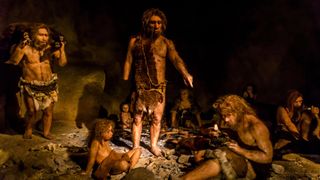
Uma reconstrução de uma família de Neandertal em uma caverna (crédito da imagem: Bjanka Kadic via Alamy Stock Photo)

Um fragmento do osso do ouvido de uma criança neandertal sugere que ela tinha síndrome de Down e que era cuidada por sua comunidade. Num estudo publicado em junho na revista Science Advances , os investigadores identificaram uma criança neandertal de 6 anos, apelidada de “Tina”, numa caverna em Espanha. O osso do ouvido de Tina, que data de 273 mil a 146 mil anos atrás, tem um formato associado à síndrome de Down, além de outras anormalidades.

Embora nenhum trabalho genético tenha demonstrado conclusivamente que Tina tinha síndrome de Down, ela teria precisado de cuidados da comunidade para sobreviver, segundo os pesquisadores, já que o osso do ouvido também sugeria que ela sofria de grande perda auditiva e vertigens. A descoberta sugere que outros neandertais estavam ajudando ela e sua mãe por um sentimento de altruísmo.

3. Os neandertais criaram uma das primeiras "fábricas de cola".Um homem de Neandertal agachado em volta de uma fogueira
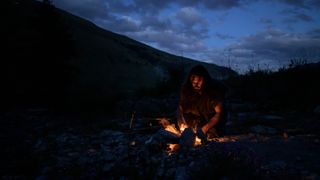
Um homem de Neandertal faz a curadoria de uma fogueira no escuro (Crédito da imagem: MARCO BERTORELLO via Getty Images)

As far back as 65,000 years ago, Neanderthals on the Iberian Peninsula were skilled engineers who made sticky tar in a precisely controlled environment. In the December issue of the journal Quaternary Science Reviews, researchers detailed their discovery of a hearth in a cave floor in Gibraltar. The hearth was full of charcoal and plant resin and was likely heated to 300 degrees Fahrenheit (150 degrees Celsius) to produce the gooey glue, which would have been used to fashion weapons such as spears.

As descobertas mostram que os Neandertais eram muito inteligentes e capazes de colaborar para produzir ferramentas complexas.

4. Os humanos modernos e os Neandertais enterraram seus mortos de maneira diferente.
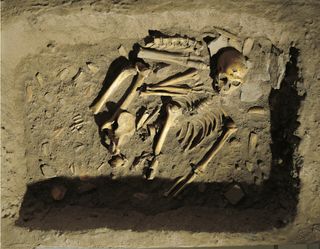
Reconstrução do sepultamento do Homem de Neandertal (Homo sapiens neanderthalensis) em La Chapelle-aux-Saints, França.

Enterro de um Neandertal em La Chapelle-aux-Saints, França (Crédito da imagem: DEA / A. Dagli Orti/De Agostini via Getty Images)

Colocar um cadáver em um buraco e cobri-lo é uma prática funerária exclusiva de humanos e neandertais. Mas os Neandertais enterraram os seus mortos de forma diferente do Homo sapiens , de acordo com uma investigação publicada este Verão na revista L'Anthropologie .

Ao observar os sepultamentos na Ásia Ocidental ao longo de um período de 85 mil anos – quando os humanos modernos e os neandertais se sobrepuseram – os pesquisadores notaram semelhanças e diferenças. Todos enterravam seus mortos independentemente de sexo ou idade, e tanto os humanos modernos quanto os neandertais colocavam itens em seus túmulos. Mas enquanto os Neandertais enterravam os seus mortos numa variedade de posições em cavernas, os primeiros H. sapiens enterravam os seus em posição fetal fora das cavernas.

Os neandertais e o H. sapiens começaram a enterrar os seus mortos durante o mesmo período – cerca de 90.000 a 120.000 anos atrás – talvez para marcar o seu território ou reivindicar certos recursos numa paisagem repleta de hominídeos.

Related: From 'Lucy' to the 'Hobbits': The most famous fossils of human relatives

5. They looked a lot like us.
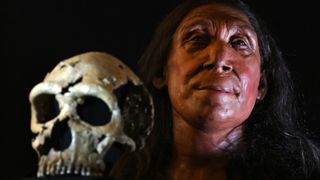
Imagem lado a lado do crânio do Neandertal 'Shanidar Z' à esquerda com sua reconstrução facial à direita. Ela pode ser vista com longos cabelos castanhos esvoaçantes e um olhar determinado.

Reconstrução do rosto do Neandertal 'Shanidar Z' à direita junto com seu crânio à esquerda. (Crédito da imagem: JUSTIN TALLIS / Colaborador via Getty Images)

Numerosos sepultamentos encontrados na caverna Shanidar, no Iraque, fornecem algumas das primeiras evidências de sepultamento proposital dos mortos. O crânio de uma mulher conhecida como Shanidar Z foi reunido a partir de centenas de fragmentos, e seu rosto foi reconstruído para fornecer a imagem de um de nossos parentes extintos.

Os crânios dos neandertais parecem diferentes dos dos humanos modernos; eles têm sobrancelhas enormes, nariz proeminente e sem queixo. Mas quando os músculos e a pele são recolocados nos ossos, mesmo que virtualmente, as semelhanças entre os neandertais e os humanos são aparentes, e a sua longa história de cruzamentos não é surpreendente.

6. Os últimos Neandertais foram isolados.
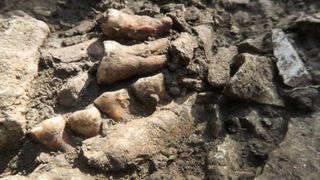
Uma mandíbula com dentes sobressai da terra

A mandíbula de 'Thorin' - um dos últimos Neandertais - emergindo da terra (Crédito da imagem: Ludovik Slimak)

O sequenciamento do DNA de um Neandertal apelidado de “Thorin” revelou que alguns grupos podem ter ficado isolados por milhares de anos antes de serem extintos. Descoberto no Vale do Ródano, na França, Thorin foi datado entre 52.000 e 42.000 anos atrás. Seu DNA sugeria que sua linhagem era bastante consanguínea, embora outros grupos de Neandertais vivessem nas proximidades.

“Como podemos imaginar populações que viveram isoladas durante 50 milénios enquanto estavam a apenas duas semanas de caminhada uma da outra?” disse Ludovic Slimak , pesquisador do Centro de Antropobiologia e Genômica de Toulouse, na França, e principal autor da pesquisa. “Tudo deve ser reescrito sobre a maior extinção da humanidade.”

7. O DNA masculino do Neandertal parece ter desaparecido sem deixar vestígios.

Cabeças humanas e de Neandertal em vitrine de museu.

Reconstruções de um humano e um Neandertal em uma vitrine de museu (Crédito da imagem: mauritius images GmbH / Alamy Stock Photo)

Embora muitos genes sejam partilhados entre os humanos modernos e os Neandertais, o genoma do H. sapiens não possui qualquer ADN do cromossoma Y do Neandertal , o que levanta a questão de como e porquê este material genético desapareceu.

Uma possibilidade intrigante é que o acasalamento simplesmente não funcionou entre homens neandertais e mulheres H. sapiens . Embora os dois grupos tenham cruzado várias vezes ao longo de milhares de anos, se uma mãe humana estivesse grávida de um bebé neandertal masculino, o seu sistema imunitário poderia ter atacado o feto masculino com genes desconhecidos do cromossoma Y durante a gravidez, resultando num aborto espontâneo. Eventualmente, se nascessem menos bebés híbridos neandertais do sexo masculino, os genes do cromossoma Y desapareceriam.

Mas ainda não é certo por que o cromossoma Y do Neandertal já não está no nosso conjunto genético evolutivo. Por ser transmitido apenas de pai para filho, pode simplesmente ter sido perdido ao longo das gerações.

8. Os Neandertais provavelmente foram absorvidos por grupos de humanos modernos.
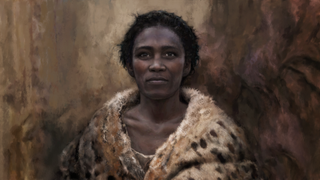
Uma ilustração de uma mulher que viveu há 45 mil anos na República Tcheca; ela tem cabelos e pele escuros e usa pele.

A reconstrução de uma mulher que viveu há 45.000 anos, na época em que os Neandertais também existiam (Crédito da imagem: Tom Björklund)

Dois estudos importantes publicados recentemente mostraram que, embora os Neandertais tenham desaparecido como grupo, muitos dos seus genes não o fizeram.

Ao observar mais de 300 genomas humanos dos últimos 45 mil anos, os investigadores estimaram que a maior parte do ADN de Neandertal que persiste em nós provém de quase 7 mil anos de cruzamentos que começaram há cerca de 47 mil anos .

Por outro lado, uma investigação publicada em julho na revista Science estimou que o genoma do Neandertal pode ter sido entre 2,5% e 3,7% humano, indicando que tanto as populações humanas como as de Neandertal tinham uma longa história de troca de parceiros. A análise genética também revelou que o tamanho da população de Neandertal era bastante pequeno. A descoberta sugere que, em vez de sofrerem uma extinção dramática, os Neandertais foram simplesmente absorvidos por grupos humanos maiores.

Relacionado: A antiga ancestral humana Lucy não estava sozinha – ela viveu ao lado de pelo menos 4 outras espécies proto-humanas, sugerem pesquisas emergentes

9. O DNA neandertal afeta nossa saúde.

Ilustração de um homem moderno abraçando uma mulher Neandertal. Eles parecem estar em uma floresta à noite. O luar está brilhando através das árvores logo atrás deles

Ilustração de um homem humano moderno abraçando uma mulher Neandertal (Crédito da imagem: Kevin McGivern para Live Science)

A pesquisa em andamento do DNA também revelou que nossa saúde é afetada pelos genes dos Neandertais , para o bem ou para o mal.

Os humanos herdaram genes neandertais para certos hormônios da gravidez, que estão associados ao aumento da fertilidade e a um menor risco de aborto espontâneo. Mas outras variantes genéticas dos nossos primos neandertais tornam-nos mais suscetíveis a alergias e diabetes tipo 2 , mais sensíveis à dor e à luz solar e mais propensos a correr risco de dependência de nicotina , COVID-19 grave , doenças autoimunes e depressão .

10. Os humanos provavelmente não mataram os neandertais – pelo menos não diretamente.
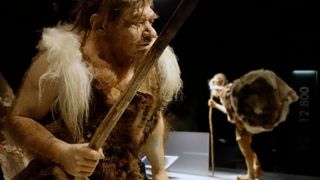
uma reconstrução de um homem de Neandertal vestindo roupas de pele

Uma estátua de um homem de Neandertal vestindo pele e carregando uma vara (Crédito da imagem: Arterra Picture Library / Alamy Stock Photo)

Também aprendemos que os humanos modernos não mataram propositalmente os últimos Neandertais do mundo . Além de absorver alguns dos Neandertais através do cruzamento e da troca de genes, os humanos parecem ter simplesmente superado os Neandertais, recorrendo às nossas vastas redes sociais quando os tempos eram difíceis e deixando os nossos primos introvertidos em dificuldades.

Então, quem foi o último Neandertal? Embora os investigadores ainda não tenham certeza, as evidências atuais apontam para o sul da Península Ibérica como um local potencial para a última resistência dos Neandertais, há cerca de 37 mil anos. Depois dessa época, os Neandertais, como grupo distinto, deixaram de existir, embora vivam, em parte, através dos genes que partilhavam connosco.

sexta-feira, 14 de abril de 2023


Quem foi nosso último ancestral comum com os neandertais?

segunda-feira, 3 de abril de 2023


Os neandertais podiam falar?

quarta-feira, 20 de maio de 2020

Oldest Homo sapiens bones found in Europe

See all authors and affiliations
Science  15 May 2020:
Vol. 368, Issue 6492, pp. 697
DOI: 10.1126/science.368.6492.697
You are currently viewing the summary.
View Full Text

Log in to view the full text

Summary

Europe has long been home to Neanderthals, who lived here from 400,000 to 40,000 years ago. But about 47,000 years ago, a new group of people took shelter in a cave in Bulgaria. There, they butchered bison, wild horses, and cave bears, leaving the cave floor littered with bones and a wealth of artifacts—ivory beads, pendants made with cave bear teeth, and stone blades stained with red ochre. Researchers used a cutting-edge toolkit of their own to identify a molar and five bone fragments as belonging to Homo sapiens, our own species. Precise new dates show these cave dwellers lived as early as 47,000 years ago, which makes them the earliest known members of our species in Europe. The work is also reigniting a long-standing debate about how Neanderthals and moderns may have influenced each other—because Neanderthals crafted similar artifacts a few thousand years later.

-------------------------------------------------------------------------------------------------------------


Ossos mais antigos do Homo sapiens encontrados na Europa

A Europa tem sido o lar de neandertais, que viveram aqui de 400.000 a 40.000 anos atrás. Mas cerca de 47.000 anos atrás, um novo grupo de pessoas se refugiou em uma caverna na Bulgária. Lá, eles massacraram bisontes, cavalos selvagens e ursos das cavernas, deixando o chão da caverna coberto de ossos e uma grande variedade de artefatos - contas de marfim, pingentes feitos de dentes de ursos e lâminas de pedra manchadas com ocre vermelho. Os pesquisadores usaram um kit de ferramentas de ponta para identificar um molar e cinco fragmentos ósseos como pertencentes ao Homo sapiens, nossa própria espécie. Novas datas precisas mostram que esses habitantes das cavernas viveram há 47.000 anos, o que os torna os primeiros membros conhecidos de nossa espécie na Europa. O trabalho também está reacendendo um longo debate sobre como os neandertais e os modernos podem ter se influenciado - porque os neandertais criaram artefatos semelhantes alguns milhares de anos depois.


sábado, 10 de agosto de 2019

Neandertals
 
  painting of Neandertal hunters in the Subarctic
  Neandertal hunters
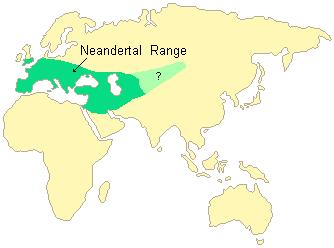
The most well-known late archaic humans were the Neandertals click this icon to hear the preceding term pronounced.  More Neandertal skeletons have been found than any other ancient human species.  They lived in Europe and Southwest Asia from at least 130,000 years ago until around 28,000 years ago.  This is in the late Pleistocene Epoch.  It is likely that the Neandertals evolved from Homo heidelbergensis in Southern Europe.  Neandertal-like skull characteristics have been found in 400,000 year old fossils from Spain.  The Neandertals adapted physically and culturally to the ice age conditions that prevailed during much of their time.

No other ancient people have aroused more controversy and confusion over the last century and a half than have the Neandertals. There is an on-going debate as to whether they should be considered Homo sapiens.  If they were members of our species, they were a different variety or race (Homo sapiens neanderthalensis).  On the other hand, if they were dissimilar enough to be a distinct species, they should be called Homo neanderthalensis click this icon to hear the preceding term pronounced.
Important Neandertal Sites
  Date of Fossil
(
years ago)

Croatia:  
  Krapina 130,000-120,000  
  Vindija 44,400-38,300
France:  
  La Ferassie 75,000-60,000
  La Chapelle-aux-Saints 56,000 or 47,000
  La Quina 75,000-40,000
  Le Moustier 40,000
  St Césaire 36,000
Germany:  
  Neandertal 40,000
Gibraltar:  
  Forbe's Quarry 70,000-45,000?
  Gorham's Cave 32,000-24,000
Italy:  
  Saccopastore 129,000-122,000?  
  Mt. Circeo 60,000-55,000
  Date of Fossil
(
years ago)
 
Iraq:  
  Shanidar 65,000-35,000
Israel:  
  Tabun 103,000-80,000  
  Kebara 60,000
  Amud 55,000-47,000
Romania:  
  Peştera Muierii 32,000
  Peştera cu Oase 30,000
Russia:  
  Mezmalskaya 70,000-60,000
  Okladnikov 38,000-30,000
Spain:  
  El Sidrón 43,000
Uzbekistan:  
  Obi-Rakhmat
  and
Anghilak
100,000-53,000?

Neandertal Discoveries
The first discovery of Neandertal bones may have been during the late 1820's in Western Europe.  Subsequently, other, better documented Neandertals were found and stored in museums without being recognized as early forms of humans.  In 1839, for instance, a portion of a child's skeleton was found in Engis, Belgium.  In 1848, an adult female skull was found at Gibraltar, at the southern tip of Spain.
 
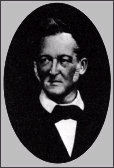
photo of Johann Karl Fuhlrott as a middile age man
Johan Karl Fuhlrott
1803-1877
In 1856 a discovery was made in Germany that finally sparked the recognition that these were, in fact, not just strange looking modern people.  This was the discovery of a skull and a number of other bones from a limestone cave deposit in the small Neander River Valley near Dïüsseldorf.  Thinking that they were from a bear, the quarrymen gave them to a local school teacher and amateur naturalist, Johan Karl Fuhlrott click this icon to hear the preceding term pronounced.  He recognized them as being human but somewhat different from those of modern Europeans.  When several leading paleontologists and medical pathologists in Germany became aware of the fossils, a disagreement developed about who the "Neandertal Man" might have been.  It was suggested that he had been an old Roman, a Dutchman, and even a Central Asian soldier in the service of the Russian czar during the Napoleonic wars of the early 19th century.  The reality that these bones were from an earlier variety or species of human was not yet conceivable to most of the scientific world in the 1850's. 
What finally convinced the scientific community that Neandertals were very ancient Europeans was a combination of additional fossil discoveries and new perspectives that largely began with the publication of Charles Darwin's On the Origin of Species in 1859.  This seminal work in biology popularized the idea that species of living things evolve over time as a result of natural selection.  Subsequently, it was not a major leap in understanding to realize that humans also must have evolved from earlier forms.  In fact, Darwin proposed just that in his 1871 influential publication The Descent of Man, and Selection in Relation to Sex.  For enlightened Victorians, the Neandertals ultimately came to be seen as important human ancestors.  They were given the name "Neandertal Man" in 1864 by William King, an Irish anatomist.  He named them after the Neander River Valley (or Tal, in German).

NOTE:  In many older books, Neandertal is spelled with a "thal" ending (Neanderthal) instead of "tal".  This is the Old German spelling that was replaced in the early 20th century.  However, the outdated usage of "thal" persists in some English publications.  It is also continued in scientific classification (Homo neanderthalensis) because it was used when Neandertal's were first described in the 19th century.  In this tutorial series, the modern "tal" is used.

In 1886, two Neandertal skeletons were found in a Belgium cave site named Spy.  These specimens were physically associated with  stone tools and food refuse bones from extinct ice age animals.  This evidence once and for all demonstrated that Neandertals were not modern people.  As a result, the majority of European paleontologists in the late 1880's finally accepted them for what they really were.
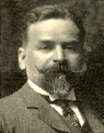
photo of Marcellin Boule  
Marcellin Boule
1861-1942  
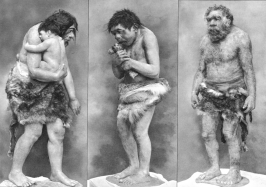
The remains of more than 400 Neandertals have been found.  The most controversial one was excavated in 1908 at La Chapelle-aux-Saints click this icon to hear the preceding term pronounced in southwestern France.  This is a nearly complete skeleton of a man who would have been elderly by Neandertal standards.  The bones were analyzed between 1911 and 1913 by the noted French paleontologist, Marcellin Boule click this icon to hear the preceding term pronounced.  Unfortunately, Boule's prejudices got in the way of scientific objectivity.  He described the La Chapelle-aux-Saints man, and subsequently all Neandertals, as dull-witted, brutish, ape-like creatures who walked hunched over with a shuffling gait.  Unfortunately, this mistaken view was universally accepted by paleoanthropologists for decades.  It also became the source of the popular images of dim-witted cavemen that still appear in cartoons and movies.
1930's diorama of 3 Neandertals--they are shown as dumb, almost ape-like creatures
Diorama of Neandertals
in an American museum
during the 1930's reflecting
the misconception reinforced
by Marcellin Boule's description
of them as dull-witted, brutish,
ape-like creatures.
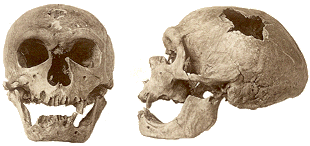
After reanalysis of the La Chapelle-aux-Saints skeleton in the 1950's, it became clear that a serious mistake had been made.  This had been an atypical Neandertal.  He was at least 40 years old with a somewhat hunched over posture resulting from severe arthritis in his spine.  There was a bowing of his legs that may have resulted from rickets disease in childhood.  He had lost most of his teeth and part of his jaw resulting in a disharmonic looking face.  Despite these deforming infirmities, it is now clear that the La Chapelle-aux-Saints man was much more like us in appearance, intelligence, and physical ability than had been believed by Marcellin Boule.
photo of front and side views of the La Chapelle-aux-Saints Neandertal skull
La Chapelle-aux-Saints man  

Analysis of Neandertal Anatomy
The Neandertals were physically diverse, but in general they were larger boned and more heavily muscled than most modern humans.  This was particularly true of the European Neandertals, like the La Chapelle-aux-Saints man.  Some of the Southwest Asian Neandertals were less robust in appearance and somewhat more like modern humans.  The Neandertals were relatively short and stocky compared to some other archaic humans and modern Europeans.  Adult male Neandertals averaged 5 feet 5 inches tall (164 cm.) and 143 pounds (65 kg).  Females averaged 5 feet 1 inch tall (155 cm) and 119 pounds (54 kg).  They probably stood as erect as we do and were fully bipedal.  They were not only strong but apparently quite flexible.  The thickness and high density of their leg bones suggest that they did a great deal of walking and running.  Their lower arm and leg bones were short compared to modern humans.  These traits were likely adaptations to an aggressive hunting and gathering way of life as well as to the cold climates in which most Neandertals lived.  The fact that adult Neandertal skeletons frequently have multiple healed bone fractures suggests that these people had rough lives.  Some researchers believe that many of the broken bones were the result of hunting large game animals up close with jabbing spears--a dangerous enterprise.
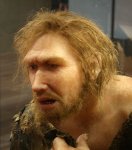
  photo of a realistic model of a Neandertal man with pale skin and red hair
  Reconstruction of the
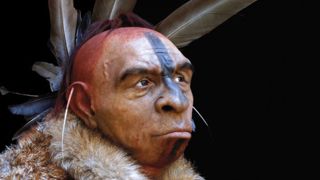
Neandertal appearance
It is likely that at least some Neandertals had pale skin color and red hair.  This is based on the discovery of a variant of the MC1R gene associated with these traits in the bones of two European Neandertals dated to around 50,000 years ago.  This was very likely an adaptation that helped their bodies produce more Vitamin D and subsequently absorb more calcium from their food in ice age Europe.
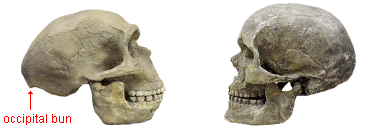
Neandertal heads were long (from front to back) compared to ours.  This resulted in relatively low, sloping foreheads.  At the back of their skulls, they had a prominent bulge or projection called an occipital bun click this icon to hear the preceding term pronounced.  They had large faces (especially in the middle part) with big noses and prominent brow ridges that extended between the eyes.  They lacked the pointed chin that is common in modern Homo sapiens.  These traits give the Neandertal face and head an appearance more reminiscent of late Homo erectus and Homo heidelbergensis than of modern people.  
photo of a Neandertal and a modern human skull shown next to each other for comparison
Neandertal   Modern human
The brain size of Neandertals was close to that of modern humans, and the structural organization of their brains was essentially the same as well.  The average Neandertal brain was actually somewhat larger than the brains of most people today.  However, the difference is minimal when people of similar body size are compared.  In fact, the average Neandertal brain may have been slightly smaller from this perspective.  The large heads and stocky bodies of Neandertals very likely were more efficient in cold climates and were probably selected for by nature.  This trend has been observed among contemporary Native American populations living in sub-arctic environments.  A larger head and more compact body shape potentially produce more body heat relative to the amount that is lost to the environment through radiation.  A bigger brain carries a high energy overhead.  The human brain uses around 20% of the energy that we get from our food when we are resting, but it is only 2% of our body mass.  This is one reason that the brains of new-born humans are only about 25% the size of those of adults.  It is hard for a pregnant woman's body to feed her own brain and that of her baby at the same time.  It is even more difficult when there are twins. 
Comparison of Cranial Capacities

  range (cm3)  
  average (cm3)   
chimpanzees 300-500   ----
australopithecines 400-515   ----
Homo habilis 509-752   612
Homo erectus 750-1250   930
Homo heidelbergensis   1100-1390   1206  
Neandertals 1200-1750   1450  
modern Homo sapiens 900-1880      1345    

Note: There is a considerable range in body and head size
among modern Homo sapiens around the world.  As a
consequence, the average brain size is smaller than would
initially seem likely. However, the average for some modern
populations (especially European and most African ones)
is slightly larger than that of Neandertals.
 
Female Neandertal brains were about 200 cm3 smaller than those of males.  This sexual dimorphism should not be a surprise since female bodies were smaller.  Modern human female brains are about 10% smaller than those of males for the same reason.

NOTE:   It would be a mistake to assume that a minor difference in overall brain size is directly correlated with intelligence among archaic or modern humans.  However, the gross difference in cranial capacity between the earliest human species 2.5 million years ago and recent Homo sapiens probably does reflect potential intelligence differences.  In order to trace the development of intelligence, speech, and other mental capabilities, it is more useful to examine changes in specific brain regions and the genes that control their development.

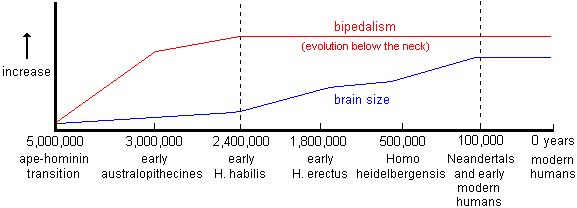
It is now clear that upright bodies and bipedal locomotion long preceded the evolution of the large human brain.  The early 20th century speculation that our ancestors would be large brained apes proved to be incorrect.  We attained the full human form of bipedalism pronounce term by about 2.5 million years ago, if not earlier.  However, the size of our brains continued to increase in a punctuated evolutionary pattern.  There apparently was a period of comparative stasis beginning around 1.8 million years ago.  However, by 800,000-600,000 years ago, human brain size began to grow very rapidly.  This skyrocketing trend continued until around 100,000 years ago or a bit earlier.
graph comparing the development of bipedalism and the later increased brain size in hominid evolution over the last 5 million years       
In other words, there was a mosaic pattern of evolution.  We continued to evolve above the neck after the rest of the body essentially reached its modern form.  This process of the brain increasing in size over and beyond that explainable by an increase in body size has been referred to as encephalization click this icon to hear the preceding term pronounced.  The overall increase in brain size was, in fact, mostly a result of changes in particular regions of the cerebrum click this icon to hear the preceding term pronounced, where most high level brain functions occur.  It is likely that nature was selecting for the mental capabilities needed to adapt rapidly to new environments.  The brain was being neurally reorganized for processing complex information.  This can be seen indirectly in the evolution of culture.  Progressively more sophisticated stone tools are, in effect, the material products of encephalization. 

Who Were the Neandertals and What Happened to Them?
We are still left with the question of whether Neandertals were members of our species or another species with whom we share a distant common ancestor.  Two sources of evidence have shed light on this issue--DNA and bones.
In 2009, a first draft of the Neandertal genome was completed.  It consists of 60% of their approximately 3 billion DNA base units.  They were sequenced mostly from bones found in Vindija Cave in Croatia.  Based on this information, Svante Paabo of the Max Planck Institute for Evolutionary Anthropology in Germany concluded that the Neandertal and modern human genomes share 99.5-99.9% of their base unit sequences.  He estimated that the Neandertal line began to diverge from ours by about 800,000 years ago and that we were "genetically distinct" by 300,000 years ago.  Further analysis of the Vindija Cave Neandertal DNA by Richard Green of the University of California, Santa Cruz led him to announce in 2010 that 1-4% of the DNA in modern Europeans and Asians came from Neandertals.  Therefore, he suggested that there must have been some interbreeding between modern humans and Neandertals around 87-37,000 years ago.  This most likely occurred in Southwest Asia, shortly after modern humans migrated out of Africa.  This would account for the lack of Neandertal DNA markers in Sub-Saharan African populations today.  The fact that many North Africans also share Neandertal DNA is likely the result of back migrations from Southwest Asia.
  The Neandertal In Us--the difficulty of finding and extracting fossil DNA
        To return here, you must click the "back" button on your browser program.
        (length = 7 mins, 37 secs)
The Neandertal DNA in modern human populations includes some of the genes for our HLA (human leukocyte antigen) immune system.  It has been suggested that this gave early modern human immigrants to Europe and Asia critical protection to diseases that had not existed in their African homeland.  Mating with Neandertals and other archaic humans in Eurasia would have helped the modern Homo sapiens adapt to viruses, bacteria, and parasitic worms that they had not been exposed to before.
Supporting evidence of interbreeding comes from 4 Neandertal skulls found in different locations in Europe.  They appear to have a mixture of Neandertal and modern Homo sapiens anatomical characteristics.  The implication is that some of the Neandertals interbred with modern humans resulting in gene flow between the populations.  If that is true, then the genetic difference between us and them must not have been as great as would be expected between two distinct species.  In other words, this would suggest that the Neandertals were a distant variety of Homo sapiens rather than a distinct species. One of the presumed Neandertal/modern human hybrids was a 4 year old child found in Portugal in 1999.  What is striking about this fossil is that it dated to 24,500 years ago--3-4,000 years after the last known Neandertal.
The size of the total Neandertal population was never very large and appears to have diminished steadily beginning around 35,000 years ago.  It is probable that at its maximum their widely dispersed population had only around 70,000 individuals with about 7,000 breeders.   The last secure date for a Neandertal site was about 28,000 years ago.  What happened to them is not clear.  However, their relatively abrupt disappearance roughly coincides with the arrival and rapid growth in numbers of modern humans in Europe.  A common view is that Neandertals could not compete effectively with the technologically more advanced and numerically larger new-comer population.  Stephen Kuhn and Mary Stiner of the University of Arizona suggest an alternative hypothesis.  They believe that modern humans entered Europe with cultures having a division of labor that was less risky for pregnant women, mothers, and young children.  They think that women mostly collected vegetables, fruits, and nuts, while men concentrated on the far more hazardous task of hunting large animals.  The occasional loss of men in hunting accidents would not have significantly affected birth rates and the survival of children.  As a consequence, there would have been a steady growth in the size of modern human populations.  In contrast, Kuhn and Stiner believe that both men and women among the Neandertals were involved in the dangerous hunting of big game animals with weapons that required close encounters with their prey.  As a result, their populations were kept low and relatively uncompetitive.
  photo of the reconstruction of the Gibraltar 2 Neandertal child based on skeletal material found at Devil's Tower
  Reconstruction of a
late Neandertal child's
appearance based
on skeletal material
found in Gibraltar

 
Another provocative hypothesis to explain the disappearance of Neandertals has been proposed by Leslie Aiello.  It is connected with the fact that Neandertals progressively became scarcer as Europe moved into the coldest phase of the last ice age.  She suggests that Neandertal habitation sites were limited to areas in which winter temperatures did not go below 0º F. (-18º C.) because their technology was not up to dealing with harsher conditions.  These relatively warmer areas would have become more and more isolated valley pockets as the climate cooled, especially after 30,000 years ago.  Eventually, they would have disappeared and the Neandertals within them would have perished from the cold.  Aiello believes that the modern humans living in Europe at that time survived because their technology for dealing with extreme ice age conditions was superior.  This hypothesis provides a logical explanation for the disappearance of most but not all Neandertals.  It does not explain why the Neandertals living in the comparatively warmer areas of Southwest Asia also became extinct.  It also is based on the questionable assumption that Neandertals were not smart or inventive enough to develop adequate technology for severe cold winter conditions.  However, it is true that around 35,000 years ago the known Neandertal habitation sites began to disappear from Central Europe.  After 30,000 years ago, they apparently only survived in what would have been the relatively warmer southern European regions of Portugal, Spain, and Gibraltar, and they ended there by about 28,000-24,000 years ago.  There was a major climatic shift to much colder conditions around 24,000 years ago.
Regardless of how they are classified or what happened to them, it has now become clear that the Neandertals were a very successful line of humans for 300-400,000 years.  They were the first people to live successfully in subarctic environments of the northern hemisphere during at least the milder phases of an ice age.  They first appeared in most of Europe during an interglacial when the climate was similar to today.  With the onset of the last ice age about 75,000 years ago, some Neandertals may have migrated to Southwest Asia (at least to Israel and Iraq) where it was warmer.  However, others adapted to the increasingly severe climatic conditions of Europe.  They did this primarily with new cultural inventions discussed in the next section of this tutorial.

Other Archaic Human Populations
Mitochondrial DNA nucleotide sequence differences between Neandertals indicate that very likely there were three different geographical populations of them.  These sub-groups lived in Western Europe, Southern Europe, and Southwestern Asia.  It also is becoming clear that the Neandertals were not the only archaic human population in Eurasia.  Mitochondrial DNA recovered from a 50,000-30,000 year old finger bone found at a Siberian cave site known as Denisova click this icon to hear the preceding term pronounced is from an up to now unknown form of human (referred to as the Denisovans click this icon to hear the preceding term pronounced).  This possible new variety or even new species of archaic human lived at the same time as Neandertals and early modern humans.  We now know that the Denisovans interbred with the early Homo sapiens whose descendents would become South Asians and Southwest Pacific Islanders.  About 1% of the DNA of some populations in South China today and 4-6% of the DNA of New Guineans and other Melanesians was inherited from the Denisovans.
 

NEWS:  Clive Finlayson of the Gibraltar Museum reported in the September 6, 2006 issue of Nature that there was a Neandertal occupation of Gorham's Cave in Gibraltar from 32,000 to 24,000 years ago.  He believes that Neandertals and modern humans lived simultaneously in Gibraltar and nearby areas of Southern Spain for several thousand years.  If his radiocarbon dates are correct, it means that Neandertals persisted in Southern Europe for upwards of 4,000 years after they are generally thought to have disappeared.