Volgatitan simbirskiensis, gen. et sp. nov., is
described based on a series of anterior and middle caudal vertebrae from
a single individual discovered in the Lower Cretaceous (upper
Hauterivian, Speetoniceras versicolor ammonite Zone) marine deposits at
Slantsevy Rudnik vertebrate locality near Ulyanovsk City, Russia. The
new taxon is characterized by strongly procoelous anterior and middle
caudal vertebrae, a long centrum of the first caudal vertebra, a strong
ventral ridge in the anterior and middle caudal vertebrae, a neural arch
positioned at the anterior half of the centrum, hyposphene-hypantrum
articulation in the anterior caudal vertebrae, and somphospondylous bone
texture. Phylogenetic analysis places the new taxon as a lithostrotian
titanosaur, a basal member of the lineage leading to the Lognkosauria.
This lineage previously contained only South American taxa with body
mass reaching 60–70 tons. Volgatitan gen. nov. is the first European and
the geologically oldest representative of this lineage. Its body mass
is estimated as 17.3 tons. Discovery of Volgatitan gen. nov. suggests
that the lithostrotian lineage leading to the Lognkosauria had a wider
distribution in the Early Cretaceous and became extinct everywhere
except South America by the end of the Early Cretaceous.
KEYWORDS: Dinosauria, Sauropoda, Titanosauriformes, Titanosauria, Lithostrotia, Early Cretaceous, Eastern Europe, Russia
Volgatitan simbirskiensis anterior caudal vertebra (holotype),
in right lateral (A), anterior (B), left lateral (C), posterior (D), dorsal (E), and ventral (F) views.
Alexander Averianov and Vladimir Efimov. 2018. The Oldest Titanosaurian Sauropod of the Northern Hemisphere. Biological Communications. 63(3), 145–162. DOI: 10.21638/spbu03.2018.301
Most people think of dinosaurs as big, ferocious and extinct reptiles.
That's largely true, but there are some misconceptions. Dinosaurs came
in all shapes and sizes. Dinosaurs were the largest land animals of all
time, but a great number of dinosaurs were smaller than a turkey.
Dinosaurs first appeared between 247 and 240 million years ago. They
ruled the Earth for about 175 million years until an extinction event
65.5 million years ago wiped out all of them, expect for the avian
dinosaurs. Scientists don't agree entirely on what happened, but the
extinction likely was a double or triple whammy involving an asteroid
impact, choking chemicals from erupting volcanoes, climate change and
possibly other factors.
Flying on
Only the big, classic dinosaurs are extinct. Birds are living
dinosaurs, most experts believe. Think of that next time a pigeon
strafes you.
Fossils show that some of the more advanced dinosaurs had feathers or
feather-like body covering, but many of them didn't fly and probably
didn't even glide. Archaeopteryx,
which was for a long time considered to be the first bird (although
this status is not certain), could likely launch itself from the ground,
but probably couldn't fly far, according to unpublished research
presented at the 2016 Society of Vertebrate Paleontology meeting in
Salt Lake City, Utah. Instead, feathers, likely helped these bird-like
dinosaurs stay warm as juveniles or send signals to other individuals.
Many people think extinct flying reptiles called pterosaurs were
dinosaurs. They were dinosaurs' closest relatives, but technically not
dinosaurs. Pterosaurs had hollow bones, relatively large brains and
eyes, and, of course, the flaps of skin extending along their arms,
which were attached to the digits on their front hands. The family
includes Pterodactyls,
with elaborate, bony head crests and lack of teeth. Pterosaurs survived
up until the mass die-off 65 million years ago, when they were went the
way of the dodo along with marine reptiles and other nonavian
dinosaurs.
Hip check
Dinosaur fossils were first recognized in the 19th century. In 1842,
paleontologist Richard Owen coined the term dinosaur, derived from the
Greek deinos, meaning "terrible" or "fearfully great," and sauros,
meaning "lizard" or reptile." Scientists classify dinosaurs into two
orders — Saurischians and Ornithischians— based on the structure of the
bones in their hips. (This saurischian and ornithischian grouping is now
disputed. See the "Family tree update" section below to learn more.)
Most of the well-known dinosaurs — including Tyrannosaurus rex, Deinonychus and Velociraptor
— fall into the order known as Saurischian dinosaurs (pronounced
sor-ISK-ee-en). These "reptile-hipped" dinosaurs have a pelvis that
points forward, similar to more primitive animals. They are often
long-necked, have large and sharp teeth, long second fingers, and a
first finger that points strongly away from the rest of the fingers.
Saurischians are divided into two groups – four legged herbivores
called sauropods and two-legged carnivores called theropods (living
birds are in the theropod lineage).
Theropods walked on two legs and were carnivorous. "Theropod" means
"beast-footed" and they are some of the fearsome and most recognizable
dinosaurs — including Allosaurus and T. rex.
Scientists have wondered whether large theropods — such as Giganotosaurus and Spinosaurus
— actively hunted their prey, or simply scavenged carcasses. The
evidence points to the animals working together as opportunistic
hunters: they would bring down prey, but also eat animals that were
lying around. When fossil-hunters found bones with bite marks on them,
they wondered if theropods engaged in cannibalism. It appears now that
the animals may have scavenged their own kind, but they didn't hunt down
their own.
Sauropods were herbivores with long heads, long necks and long tails.
They were among the largest land animals ever, but they likely had small
brains. The gentle giants like leaf-eating Apatosaurus, Brachiosaurus and Diplodocus are part of this family.
Ornithischia
Ornithischian (pronounced or-neh-THISK-ee-en) dinosaurs, a group that includes horned and frilled Triceratops, spiked Stegosaurus and armored Ankylosaurus, are more mild-mannered, plant eaters.
These dinosaurs were beaked herbivores. Smaller than the sauropods, the
ornithischia (meaning "bird-hipped") often lived in herds and were prey
to the larger species of dinosaurs. Interestingly, the ornithischia
shifted from a two-legged to a four-legged posture at least three times
in their evolutionary history and scientists think they could adopt both
postures early in their evolutionary history.
Family tree update
In 2017, a metaphorical bombshell hit the paleontology world regarding
the dinosaur family tree. A study published in the journal Nature
suggested that this hip-oriented classification was incorrect. Rather,
theropods are likely close cousins with the ornithischian dinosaurs, and
the two groups — the theropods and Ornithischia — form a newly
identified group known as Ornithoscelida, the researchers said.
The old (left) and the new (right) dinosaur family tree.
Credit: University of Cambridge
The finding came about after researchers realized that theropods and Ornithischia had many anatomical features in common.
If the updated tree is correct, it may explain why both theropods and
Ornithischia have feathers, while other dinosaurs don't.
However, this hypothesis will need to be tested and retested over the
next several years before the paleontology community can fully accept
it.
Marine reptiles
During the age of the dinosaurs, a lot was happening below the surface
of the world's oceans. The "fish flippers," or ichthyopterygia, includes Ichthyosaurus —
the streamlined, tuna- and dolphin-shaped ocean-going predators. This
abundant family of marine reptiles largely went extinct at the end of
the Jurassic Period.
Dinosaur cloning
Despite the popularity of the "Jurassic Park" franchise, it would be
incredibly difficult, if not impossible, to clone a dinosaur. In order to clone a dinosaur,
researchers would need dinosaur DNA. But there is no known surviving
dinosaur DNA on record (the oldest recovered and authenticated DNA
sample belongs to a 700,000-year-old horse that lived in ancient
Canada.)
However, some dinosaur organic matter has withstood the test of time.
Researchers have uncovered a number of soft tissues from the Mesozoic
era, including 80-million-year-old blood vessel belonging to a duck-billed dinosaur and 130-million-year-old proteins in an early bird fossil. But blood vessels and proteins, unlike DNA, cannot be used to clone animals.
There is a concerted effort to reverse engineer a chicken into a
dinosaur (remember, birds are the descendants of theropod dinosaurs),
but the team still has a ways to go. Additional reporting by staff writer Laura Geggel.
terça-feira, 30 de janeiro de 2018
Do tamanho de um ônibus e com o peso de um elefante: nova espécie de dinossauro é descoberta no Saara
Andrew McAfee/Carnegie Museum of Natural History/Reuters
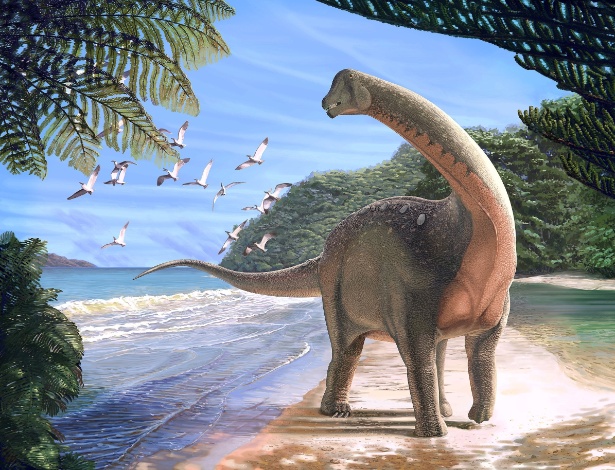
Reconstrução do dinossauro "Mansourasaurus shahinae", que viveu há cerca de 80 milhões de anos no deserto ocidental do Egito
Cientistas do Egito descobriram no deserto do Saara Oriental o
'Mansourasaurus shahinae', uma nova espécie de dinossauro do período
Cretáceo cujos fósseis oferecem nova informação sobre a vida destes
animais ao fim de sua existência, segundo um estudo publicado nesta
segunda-feira (29) na revista "Nature".
Este novo tipo de
titanossauro pertence ao grupo dos saurópodes, entre os quais se
encontram outros grandes herbívoros de pescoço longo como o
'Argentinossauro' e o 'Patagotitan mayorum', ambos encontrados no Cone
Sul da América.
O "Mansourasaurus" encontrado no Saara egípcio
tem um tamanho menor que esses dois gigantes, com um comprimento similar
ao de um ônibus médio e o peso de um elefante adulto, e viveu durante o
Cretáceo Tardio, entre 100 e 66 milhões de anos, num período próximo de
sua extinção, informaram os responsáveis pela pesquisa, liderada pela
Universidade de Mansoura.
Os restos fósseis de dinossauros
dessa época, segundo os paleontólogos, são poucos, por isso sua história
evolutiva no continente africano era, até agora, um mistério para os
cientistas.
"O 'Mansourasaurus' nos ajudará a abordar questões
pendentes sobre os registros fósseis da África e sua paleobiologia,
quais os animais que viviam ali e com que outras espécies estavam (os
dinossauros) aparentados de maneira mais próxima", destacou um dos
coautores do estudo, Eric Gorscak.
A vegetação frondosa de
algumas partes da África, segundo os especialistas, dificultou o
trabalho de busca de restos fósseis, em comparação com a visibilidade de
outras áreas como a do deserto de Gobi (Ásia), das Montanhas Rochosas
(América do Norte) e da Patagônia (América do Sul).
Andrew McAfee/Carnegie Museum of Natural History/Reuters
Este novo tipo de titanossauro pertence ao grupo dos saurópodes
Nesse sentido, a escassez de fósseis do Cretáceo Tardio nesta região do
planeta dificultou os estudos sobre essa época crucial para entender a
extinção dos dinossauros, que coincidiu, além disso, com um período de
profundas mudanças geológicas e geográficas.
Durante a maior
parte dos períodos Triássico e Jurássico, todos os continentes atuais
formavam a Pangea, o supercontinente que começou a se dividir em massas
de terra separadas pelos oceanos no Cretáceo.
A informação
disponível até agora não explica adequadamente que tipo de vínculos
tinha a fauna africana durante essa época com outras massas terrestres
do hemisfério sul e da Europa, nem como tinham evoluído em relação a
seus vizinhos após a separação dos continentes.
Após analisar
as características da estrutura óssea do 'Mansourasaurus shahinae', um
dos poucos dinossauros do Cretáceo encontrados na África, os
especialistas determinaram que este titanossauro tem mais vínculos com
os da Europa e da Ásia do que com os da América do Sul e da parte
meridional do continente africano.
Isto demonstra, além disso,
que, ao final da sua existência como espécie, os "últimos dinossauros da
África não estiveram completamente isolados, como se propunha no
passado", mas que alguns "ainda mantiveram conexões com a Europa",
segundo Gorscak.
Receba notícias do UOL. É g
sexta-feira, 22 de janeiro de 2016
[Paleontology • 2016]
Notocolossus gonzalezparejasi • A Gigantic New Dinosaur from Argentina and the Evolution of the Sauropod Hind Foot
Titanosauria is an exceptionally diverse, globally-distributed clade of
sauropod dinosaurs that includes the largest known land animals.
Knowledge of titanosaurian pedal structure is critical to understanding
the stance and locomotion of these enormous herbivores and, by
extension, gigantic terrestrial vertebrates as a whole. However,
completely preserved pedes are extremely rare among Titanosauria,
especially as regards the truly giant members of the group. Here we
describe Notocolossus gonzalezparejasi gen. et sp. nov.
from the Upper Cretaceous of Mendoza Province, Argentina. With a
powerfully-constructed humerus 1.76 m in length, Notocolossus is one of
the largest known dinosaurs. Furthermore, the complete pes of the new
taxon exhibits a strikingly compact, homogeneous metatarsus—seemingly
adapted for bearing extraordinary weight—and truncated unguals,
morphologies that are otherwise unknown in Sauropoda. The pes underwent a
near-progressive reduction in the number of phalanges along the line to
derived titanosaurs, eventually resulting in the reduced hind foot of
these sauropods.
Systematic palaeontology
Dinosauria Owen, 1842
Saurischia Seeley, 1887
Sauropoda Marsh, 1878
Titanosauriformes Salgado, Coria, and Calvo, 1997
Somphospondyli Wilson and Sereno, 1998
Titanosauria Bonaparte and Coria, 1993
Lithostrotia Upchurch, Barrett, and Dodson, 2004
Notocolossus gonzalezparejasi gen. et sp. nov.
Etymology: From the Greek notos (southern) and the Latin colossus, in reference to the gigantic size and Gondwanan provenance of the new taxon. Species name honours Dr. Jorge González Parejas,
who has collaborated and provided legal guidance on the research,
protection, and preservation of dinosaur fossils from Mendoza Province
for nearly two decades. In so doing, he has advised researchers on the
creation of a natural park that serves to protect dinosaur footprints in
Mendoza.
Figure 2: Vertebral morphology of Notocolossus gonzalezparejasi.
Anterior (second or third) dorsal vertebra of the holotype (UNCUYO-LD
301) in (a) anterior and (b) left anterolateral views. Anterior caudal
vertebra of the holotype (UNCUYO-LD 301) in (c) anterior, (d) posterior,
and (e) right lateral views. Anterior caudal vertebra of the referred
specimen (UNCUYO-LD 302) in (f) anterior, (g) posterior, and (h) left
lateral views.
Holotype: UNCUYO-LD 301, an associated partial skeleton of a very
large individual consisting of an anterior dorsal vertebra, an anterior
caudal vertebra, the right humerus, and the proximal end of the left
pubis (Figs 1b, 2a–e, 3a,c,e,g and 4a–c; Supplementary Figs S1, S3). We
consider these elements to represent a single titanosaurian individual
because they were found within an area of 8 m by 8 m at the same
stratigraphic level and are of the appropriate size and morphology to
have been derived from a single skeleton.
Figure 4: Appendicular skeletal morphology of Notocolossus gonzalezparejasi.
(a) Right humerus of the holotype (UNCUYO-LD 301) in anterior view.
Proximal end of the left pubis of the holotype (UNCUYO-LD 301) in
lateral (b) and proximal (c) views. Right tarsus and pes of the referred
specimen (UNCUYO-LD 302) in (d) proximal (articulated, metatarsus only,
dorsal [=anterior] to top), (e) dorsomedial (articulated), and (f)
dorsal (disarticulated) views.
Type locality and horizon: Cerro Guillermo, Malargüe Department,
southern-most Mendoza Province, Argentina (Fig. 1a; coordinates on file
at UNCUYO-LD). The holotype and referred specimen were collected 403 m
apart in the basal-most bed of the Upper Cretaceous (upper
Coniacian–lower Santonian, ~86 Ma) Plottier Formation of the Neuquén
Group (see Supplementary Information for details).
Figure 5: Hypothesized phylogenetic position of Notocolossus gonzalezparejasi and pedal evolution of Sauropoda.
(a) Time-calibrated hypothesis of phylogenetic relationships of
Notocolossus with relevant clades labelled. Depicted topology is that of
the single most parsimonious tree of 720 steps in length (Consistency
Index = 0.52; Retention Index = 0.65). Stratigraphic ranges (indicated
by coloured bars) for most taxa follow Lacovara et al.4: fig. 3 and
references therein. Additional age sources are as follows: Apatosaurus, Cedarosaurus, Diamantinasaurus, Diplodocus, Europasaurus, Ligabuesaurus, Neuquensaurus, Omeisaurus, Saltasaurus, Shunosaurus, Trigonosaurus, Venenosaurus, Wintonotitan. Stratigraphic ranges
are colour-coded to also indicate geographic provenance of each taxon:
Africa (excluding Madagascar), light blue; Asia (excluding India), red;
Australia, purple; Europe, light green; India, dark green; Madagascar,
dark blue; North America, yellow; South America, orange. (b–h) Drawings
of articulated or closely associated sauropod right pedes in dorsal
(=anterior) view, with respective pedal phalangeal formulae and total
number of phalanges per pes provided (the latter in parentheses). (b) Shunosaurus (ZDM T5402, reversed and redrawn from Zhang); (c) Apatosaurus (CM 89); (d) Camarasaurus (USNM 13786); (e) Cedarosaurus (FMNH PR 977, reversed from D’Emic32); (f) Epachthosaurus (UNPSJB-PV 920, redrawn and modified from Martínez et al.22); (g) Notocolossus; (h) Opisthocoelicaudia (ZPAL
MgD-I-48). Note near-progressive decrease in total number of pedal
phalanges and trend toward phalangeal reduction on pedal digits II–V
throughout sauropod evolutionary history (culminating in phalangeal
formula of 2-2-2-1-0 [seven total phalanges per pes] in the latest
Cretaceous derived titanosaur Opisthocoelicaudia). Abbreviation: Mya,
million years ago.
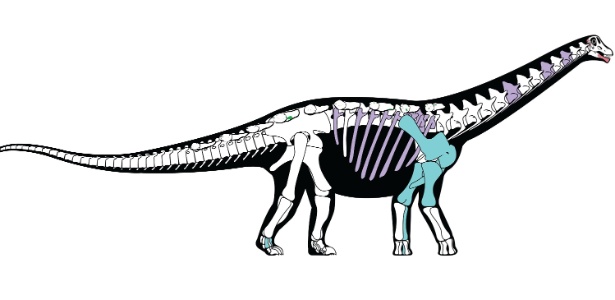
Figure 1: Geographic provenance and speculative reconstruction of the gigantic titanosaurian sauropod dinosaur Notocolossus gonzalezparejasi gen. et sp. nov. (a) Type locality of Notocolossus (indicated
by star) in southern-most Mendoza Province, Argentina. (b)
Reconstructed skeleton and body silhouette in right lateral view, with
preserved elements of the holotype (UNCUYO-LD 301) in light green and
those of the referred specimen (UNCUYO-LD 302) in orange. Scale bar, 1
m.
(All images were hand drawn by the senior author [B.J.G.R.] and subsequently edited using Adobe Illustrator software.)DOI: 10.1038/srep19165
Bernardo J. González Riga, Matthew C. Lamanna, Leonardo D. Ortiz David,
Jorge O. Calvo and Juan P. Coria. 2016. A Gigantic New Dinosaur from
Argentina and the Evolution of the Sauropod Hind Foot. Scientific Reports 6, Article number: 19165. DOI: 10.1038/srep19165
The name Brontosaurus has endured in popular culture, such as this 1989 US stamp.
The Brontosaurus is back. Dinosaur fossils that were originally described as Brontosaurus excelsus in 1879 and later renamed should indeed be classified as Brontosaurus, a study of dozens of dinosaur specimens concludes.
That may not sit well with palaeontology aficionados, who love to point out that Brontosaurus has
not been a valid taxonomic name since the early twentieth century.
(Just ask the US Postal Service, which was roundly criticized after it
released a Brontosaurus postage stamp in 1989.)
The rise, fall and now rise of the Brontosaurus has its roots in the ‘bone wars’
of nineteenth-century palaeontology. While some prospectors dug up the
American West in search of mineral fortunes in the middle to late 1800s,
others looked for giant lizards. A race between palaeontologists Edward
Cope and Othniel Marsh defined the era.
“Cope
and Marsh were big rivals,” says Emanuel Tschopp, a palaeontologist at
the Nova University of Lisbon, Portugal, who led the latest study,
published on 7 April in the journal PeerJ1.
“They really rushed new species into press as fast as possible, and
many of these reference specimens on which they based new species are
extremely fragmentary and are not comparable directly.”
Working in Colorado’s Morrison formation in 1877, Marsh’s field crew uncovered the gargantuan bones of a species he dubbed Apatosaurus ajax
— a genus name that translates to deceptive lizard, and a species name
that references the Greek hero Ajax. Two years later, Marsh found
another giant dinosaur in the same rock formation and named it Brontosaurus excelsus, the noble thunder lizard.
In the early 1900s, after discovering a fossil that was similar to both Brontosaurus and Apatosaurus,
other researchers decided that the two dinosaurs were distinct species
of the same genus. Subsequent studies only raised further questions
about the status of Brontosaurus.
Palaeontologists eventually agreed that Brontosaurus is properly called Apatosaurus,
under taxonomic rules drafted by the eighteenth-century Swedish
systematist Carl Linnaeus and still in use today. The rules state that
the first name given for an animal takes priority. The bones attributed
to Brontosaurus excelsus, therefore, belonged to Apatosaurus excelsus.
Davide Bonadonna
The first known Brontosaurus fossil was unearthed in the Morrison formation in Colorado.
Drawing a family tree
Tschopp didn't set out to resurrect the Brontosaurus when he started analysing different specimens of diplodocid — the group to which Apatosaurus, Diplodocus
and other giants belong. But he was interested in reviewing how the
fossils had been classified and whether anatomical differences between
specimens represented variation within species, or between species or
genera. Tschopp and his colleagues analysed nearly 500 anatomical traits
in dozens of specimens belonging to all of the 20 or so species of
diplodocids to create a family tree. They spent five years amassing
data, visiting 20 museums across Europe and the United States.
Very
broadly, their tree confirmed established ideas about the evolutionary
relationships among diplodocids. But the scientists also concluded that Apatosaurus and Brontosaurus
were different enough to belong in their own genera. Many of the
anatomical differences between the two dinosaurs are obscure, Tschopp
says, but Apatosaurus’s stouter neck is an obvious one. “Even though both are very robust and massive animals, Apatosaurus is even more so,” he adds.
Tschopp and his team thought very carefully about their decision to reinstate Brontosaurus, and they expect some pushback. “We knew it would be a major finding because Brontosaurus
is such a popular name,” he says. “I’m pretty sure there will be a
scientific discussion around this. I hope there will be. That’s how
science works.”
The resurrection of Brontosaurus may grab all the headlines, but the analysis also reshuffles some other dinosaurs. A species called Diplodocus hayi got its own genus, Galeamopus. Meanwhile, the team determined that a dinosaur from Portugal called Dinheirosaurus belongs in the genus Supersaurus, remains of which have been found only in North America.
The name game
The
paper represents “the best current view” of diplodocids, says Michael
Benton, a vertebrate palaeontologist at the University of Bristol, UK.
The traits that distinguish Brontosaurus from Apatosaurus are in line with characteristics that define other genera of sauropod, the larger dinosaur group to which diplodocids belong.
“The discrimination of Brontosaurus from Apatosaurus
will be startling,” he says. “It’s the classic example we always use to
explain the meaning of ‘synonym’ to students, or as an example of the
speed and dastardly deeds of Marsh and Cope as they each rushed to name
new taxa, sometimes the same beast.”
Philip Mannion, a palaeontologist at Imperial College London, says the study is important not only for its resurrection of Brontosaurus.
By determining which diplodocid bones fall under which species and
genus, it should make it easier for palaeontologists to correctly
classify new finds while helping them to understand the evolution of
some of the largest dinosaurs that lived.
“The public is going to get a lot out of this because Brontosaurus has this very prominent place in the public imagination,” says Mannion, who has a personal stake in the issue.
Several years ago, he was contacted by a poster company asking whether Brontosaurus was a valid dinosaur name. “A father had bought a poster for his child, and the child straight away said Brontosaurus isn’t a real dinosaur,” remembers Mannion, who told the company that the kid was right.
Will Mannion now tell the firm that the Brontosaurus is back? “Maybe I’ll let them get in touch,” he says.
“Cope
and Marsh were big rivals,” says Emanuel Tschopp, a palaeontologist at
the Nova University of Lisbon, Portugal, who led the latest study,
published on 7 April in the journal PeerJ1… in article
terça-feira, 7 de abril de 2015
[Paleontologia • 2015]
A Specimen-Level Phylogenetic Analysis and Taxonomic Revision of Diplodocidae (Dinosauria, Sauropoda)
Diplodocidae are among the best known sauropod dinosaurs. Several
species were described in the late 1800s or early 1900s from the
Morrison Formation of North America.
Since then, numerous additional
specimens were recovered in the USA, Tanzania, Portugal, and Argentina,
as well as possibly Spain, England, Georgia, Zimbabwe, and Asia. To
date, the clade includes about 12 to 15 nominal species, some of them
with questionable taxonomic status (e.g., ‘Diplodocus’ hayi or Dyslocosaurus polyonychius),
and ranging in age from Late Jurassic to Early Cretaceous. However,
intrageneric relationships of the iconic, multi-species genera Apatosaurus and Diplodocus are
still poorly known. The way to resolve this issue is a specimen-based
phylogenetic analysis, which has been previously implemented for Apatosaurus, but is here performed for the first time for the entire clade of Diplodocidae.
The analysis includes 81 operational taxonomic units, 49 of which belong
to Diplodocidae. The set of OTUs includes all name-bearing type
specimens previously proposed to belong to Diplodocidae, alongside a set
of relatively complete referred specimens, which increase the amount of
anatomically overlapping material. Non-diplodocid outgroups were
selected to test the affinities of potential diplodocid specimens that
have subsequently been suggested to belong outside the clade. The
specimens were scored for 477 morphological characters, representing one
of the most extensive phylogenetic analyses of sauropod dinosaurs.
Character states were figured and tables given in the case of numerical
characters.
The resulting cladogram recovers the classical arrangement of diplodocid
relationships. Two numerical approaches were used to increase
reproducibility in our taxonomic delimitation of species and genera.
This resulted in the proposal that some species previously included in
well-known genera like Apatosaurus and Diplodocus are
generically distinct. Of particular note is that the famous genus
Brontosaurus is considered valid by our quantitative approach.
Furthermore, “Diplodocus” hayi represents a unique genus, which will herein be called Galeamopus gen. nov. On the other hand, these numerical approaches imply synonymization of “Dinheirosaurus”
from the Late Jurassic of Portugal with the Morrison Formation genus
Supersaurus. Our use of a specimen-, rather than species-based approach
increases knowledge of intraspecific and intrageneric variation in
diplodocids, and the study demonstrates how specimen-based phylogenetic
analysis is a valuable tool in sauropod taxonomy, and potentially in
paleontology and taxonomy as a whole.
Life restoration: “Brontosaurus as researchers see it today – with a Diplodocus-like head”
Emanuel Tschopp, Octávio Mateus and Roger B.J. Benson. 2015. A
Specimen-Level Phylogenetic Analysis and Taxonomic Revision of
Diplodocidae (Dinosauria, Sauropoda).