Rebecca MorelleCorrespondente científica, BBC News
7 de julho de 2014
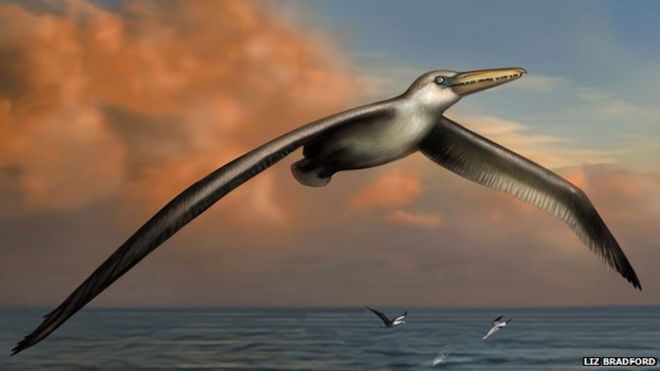
Direito de imagemLiz BradfordImage captionO pássaro gigante teria sido um aviador elegante, capaz de voar pelo oceano antigo em busca de comida
Os restos fossilizados da maior ave voadora já encontrada foram identificados pelos cientistas.
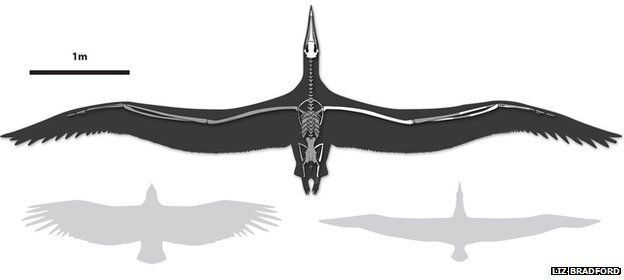
Essa criatura teria parecido uma gaivota usando esteroides - sua envergadura estava entre 6,1 e 7,4 m (20-24 pés). A descoberta é publicada nos Anais da Academia Nacional de Ciências .
O fóssil de 25 anos de idade foi descoberto há 30 anos na Carolina do
Sul, mas levou até agora para identificar que se trata de uma nova
espécie.
Daniel Ksepka, curador de ciências do Museu Bruce, em Connecticut,
disse: "Este fóssil é notável tanto pelo tamanho, sobre o qual
poderíamos especular antes da descoberta, quanto pela preservação. "O crânio em particular é requintado.
"E dada a natureza delicada dos ossos ... é notável que o espécime
chegou ao fundo do mar, foi enterrado sem ser destruído por catadores,
fossilizado e depois foi descoberto antes de ser erodido ou destruído". Os pesquisadores acreditam que este enorme pássaro supera o anterior gravador, Argentavis magnificens
- um pássaro semelhante ao condor da América do Sul com uma envergadura
estimada de 5,7 a 6,1 m (19 a 20 pés) que viveu cerca de seis milhões
de anos atrás. Direito de imagemLiz BradfordLegenda da imagemO pássaro teria superado nossos maiores pássaros vivos - o condor da Califórnia (à esquerda) e o albatroz (à direita)Os cientistas chamaram o novo gigante Pelagornis sandersi . Eles acreditam que seria o dobro do tamanho do albatroz-errante, o maior pássaro vivo.
Como o albatroz, era uma ave marinha, passando a maior parte do tempo mergulhando sobre o oceano, caçando peixes e lulas. Apesar de sua escala, teria sido um folheto elegante.
Legenda da mídia O curador do Bruce Museum, Daniel Ksepka: Fossil é "espetacular"
Embora os modelos teóricos sugiram que seria difícil para um pássaro
desse tamanho permanecer no ar batendo as asas, os pesquisadores
acreditam que ele usou correntes de ar para voar acima do oceano. Suas asas longas e esbeltas e ossos leves e ocos o tornariam um planador poderoso. "Teria sido rápido e muito eficiente", disse Ksepka.
"Os modelos de computador sugerem que ele possui altas taxas de
elevação / arrasto, o que permitiria deslizar por uma distância muito
longa para cada unidade de altitude que pudesse atingir.
"Provavelmente poderia deslizar a velocidades acima de 10m por segundo -
mais rápido do que o recorde mundial humano para os 100m." Em terra, porém, a ave marinha provavelmente era muito menos graciosa. "As asas longas teriam sido pesadas e provavelmente gastariam o mínimo de tempo possível andando por aí", explicou Ksepka. Descolar também teria sido um assunto desagradável. Modelos de computador revelam que o pássaro não poderia ter decolado simplesmente parado e batendo as asas. Em vez disso, os cientistas acham que P. sandersi pode ter tido que caminhar ladeira abaixo e esperar pegar uma rajada de ar. Pássaros enormes como esse já foram comuns, mas desapareceram cerca de três milhões de anos atrás. Os cientistas ainda não entendem por que esses gigantes do céu morreram.
quinta-feira, 21 de março de 2019
Barbara Marrs
Unlaid egg discovered in ancient bird fossil
Ovo descascado descoberto no fóssil antigo do pássaro
Pela primeira vez, pesquisadores descobriram um óvulo não coberto dentro de uma ave fossilizada. O achado - pertencente a um panfleto do tamanho de um pardal que viveu no noroeste da China há 110 milhões de anos - é especialmente notável porque os ovos totalmente formados normalmente ficam apenas dentro de uma ave adulta por cerca de 24 horas.
Researchers were initially puzzled by the discovery, as they never
suspected the unusual, squashed mass within the headless fossil’s
abdomen (seen as a flattened brown layer in the center of the picture)
could be an egg. But a microscopic analysis of a fragment revealed it to
be eggshell. Further study suggested structural abnormalities that hint
that the egg may have been the cause of this bird’s demise, the paleontologists report today in Nature Communications.
The fossil eggshell’s structure doesn’t have the correct proportions
seen in healthy eggs and consists of multiple layers of shell. This
indicates a condition called “egg-binding,” where an egg becomes trapped
inside a bird, the team argues. This can occur in chickens and small
varieties of modern pet birds under stress and likely also led to the
death of this long-lost, dinosaur-era relative.
This makes the discovery “the oldest documented case of this common
reproductive disorder,” the researchers say. Intriguingly, the eggshell
features microscopic spheres of calcium phosphate, which is seen today
in birds that nest in humid, infection-prone environments. This
waterproofing suggests it was a species that nested near water and
buried its eggs in the ground.
The team has christened the bird Avimaia schweitzerae. (Avimaia means “mother bird”; and schweitzerae honors paleontologist Mary Schweitzer.)
Coruja fóssil de 48 milhões de anos está quase perfeitamente preservada
By Laura Geggel, Senior Writer |
O pedaço rochoso segurando os frágeis ossos fossilizados da antiga coruja, ao lado de um quarto para comparação de tamanho.
Credit: John Alexander
ALBUQUERQUE, N.M. — Cerca de 48 milhões de anos atrás, uma coruja voou para pegar sua presa, não pela luz da lua, mas em plena luz do dia.
Como os paleontologistas sabem que essa ave não era uma coruja da noite? Eles encontraram os restos primorosamente preservados de uma coruja e seu crânio compartilha uma característica reveladora com os falcões modernos, que também caçam de dia, disseram os pesquisadores.
A constatação é extraordinário, em grande parte porque é raro encontrar corujas fossilizados, especialmente um que tem tantos ossos preservados, disse o co-pesquisador do projeto Elizabeth Freedman Fowler, professora assistente na Universidade Estadual de Dickinson em Dakota do Norte, que dublou o espécime "o mais fino coruja fóssil ".
"Não há coruja fóssil com uma caveira como esta", disse Freedman Fowler à Live Science. "Caveiras de pássaros são incrivelmente finas e frágeis, então ter uma ainda preservada em três dimensões, mesmo que levemente esmagada, é incrível. Tem até os hioides no fundo, os ossos que se ligam aos músculos da língua."
O crânio está em tão boa forma que os pesquisadores notaram que os processos supraorbitais (as regiões acima das órbitas oculares) têm uma saliência óssea, fazendo parecer que a coruja tinha um mini boné de beisebol em cima de cada olho, de acordo com a pesquisa. , que foi apresentado aqui na 78ª reunião anual da Sociedade de Paleontologia de Vertebrados em 19 de outubro. O estudo ainda não foi publicado em um periódico revisado por pares.
Essa saliência "dá sombra para que você não fique ofuscado [pelo sol]", disse o pesquisador-chefe do projeto, Denver Fowler, curador de paleontologia do Museu de Dinossauros de Badlands, em Dakota do Norte. Esse recurso é fraco ou ausente em corujas noturnas, mas é comum em falcões modernos e corujas diurnas, observou ele.
Como outros falcões (e como a coruja antiga), este açor do norte tem uma crista sobre os olhos que os protege do sol.
Credit: Shutterstock
A descoberta não é completamente inesperada. As aves são criaturas diurnas - ou diurnas - e, em algum ponto evolutivo, a coruja mudou de rumo e tornou-se noturna, disse ele. Além disso, há corujas diurnas hoje em dia, incluindo a coruja-do-norte (Surnia ulula) e a coruja pigmeu do norte (Glaucidium gnoma), Marc Devokaitis, especialista em informações públicas do Laboratório de Ornitologia Cornell em Ithaca, Nova York. Ciência Viva.
O que não está claro é se esse espécime misterioso era uma forma primitiva de coruja que caçava durante o dia, antes que a maioria das corujas se tornasse noturna, ou se era uma coruja que caçava durante o dia enquanto outras corujas perseguiam a noite, disse Fowler. .
Aves encontrar
Ao todo, os pesquisadores têm cerca de 45% do esqueleto da coruja, incluindo o crânio e os ossos das pernas, pés, asas e mandíbula. Isso é muito mais material do que o encontrado com outras descobertas de corujas fossilizadas - algumas das quais recebem nomes científicos baseados em um único fragmento de um osso, disse Freedman Fowler.
A coruja foi descoberta pelo pesquisador John Alexander, pesquisador associado do Museu Burke de História Natural e Cultura da Universidade de Washington, enquanto escavava fósseis de antigos animais parecidos com lêmures conhecidos como Notharctus e Smilodectes no Bridger. Formação do sudoeste do Wyoming em 2007. Tendo em conta que ele estava à procura de mamíferos, ele disse que ficou surpreso ao encontrar uma ave de rapina.
"Este é o primeiro esqueleto de aves predadoras encontrado nessa formação, e as pessoas têm procurado por 150 anos", disse Alexander à Live Science. [Whooo está lá? Imagens de Corujas Incríveis]
No entanto, não foi até recentemente, depois de mostrar o espécime para Fowler, que Alexander percebeu que o espécime era uma coruja - um pouco maior que uma coruja de celeiro moderna.
(Tyto alba).
A coruja recém descoberta é provavelmente um pouco maior que uma coruja de celeiro moderna (Tyto alba).
Credit: Shutterstock
Ainda não está claro se a coruja é uma espécie recém-descoberta, ou se já é conhecida na literatura científica, mas apenas a partir de um fragmento, disse Freedman Fowler. Mas eles esperam descobrir em breve, assim como aprender o máximo possível sobre o antigo caçador.
"Nós apenas CT [tomografia computadorizada] digitalizados isso, então vamos obter os resultados de volta em breve", disse Freedman Fowler. "Podemos olhar para coisas como a mobilidade do pescoço - temos as vértebras cervicais, para que possamos ver até onde ela pode mover o pescoço."
Além disso, a caixa craniana (a parte interna do crânio que continha o cérebro da coruja) está bem preservada, "então estaremos olhando para as diferentes partes do cérebro para ver como eram seus sentidos, [incluindo] quão bem ele podia ouvir e quão bem ele podia ver ", disse ela.
Esta não foi a única coruja encontrada na conferência. Peter Houde, professor de biologia da Universidade Estadual do Novo México, encontrou ossos de duas espécies diferentes de corujas nos leitos Clarkforkian-Wasatchianos do centro-norte de Wyoming, um com cerca de 56 milhões e outro com cerca de 55 milhões de anos atrás. Isso é um pouco mais jovem que Ogygoptynx, a mais antiga coruja registrada, que viveu no que hoje é o Colorado há 61 milhões de anos, poucos milhões de anos depois que os dinossauros não-humanos foram extintos há cerca de 65 milhões de anos, disse Houde ao Live Science.
quinta-feira, 3 de março de 2016
[PaleoOrnithology • 2016]
Dromornis murrayi • The Extinct Flightless Mihirungs (Aves, Dromornithidae): Cranial Anatomy, A New Species, and Assessment of Oligo-Miocene Lineage Diversity
ABSTRACT
Giant flightless fowl (Aves, Dromornithidae) similar to the Northern
Hemisphere gastornithids and weighing up to 350–650 kg evolved on
Gondwana and existed in what is now Australia from the Eocene to the
late Quaternary. Understanding cranial morphology of dromornithids has
until now been based almost wholly on species of Dromornis, with
that of species in three other genera either previously unknown or very
fragmentary. Here we rectify this deficiency and describe a
well-preserved cranium from the middle Miocene Bullock Creek Local Fauna
referred to Ilbandornis woodburnei, rich, fragmentary crania,
quadrates, pterygoids, and mandibles for the Oligo-Miocene Barawertornis tedfordi Rich, and additional material of the species of Ilbandornis.
The morphological similarity of this cranial material suggests that the
emu-sized B. tedfordi is a smaller precursor to and differs little from
species of Ilbandornis. Dromornis murrayi, n. sp.,
from late Oligocene–Early Miocene sites at Riversleigh, based on
cranial and postcranial elements, is the oldest and smallest species in
its genus. Placed in the context of other data, these observations
suggest that the dromornithids comprised only two lineages throughout
the Oligo-Miocene. The Barawertornis-Ilbandornis lineage attained
maximum diversity in the middle Miocene Bullock Creek and late Miocene
Alcoota local faunas (LF), with two species in each, but the Dromornis
lineage seems to have been monotypic throughout its temporal range. The
low diversity of these giant galloanseres in Australia mirrors that of
the giant herbivorous ratites (ostriches and kin), which similarly have
low diversity where they coevolved with diverse mammalian faunas.
Dromornis murrayi, A newly discovered flightless bird, reached 1.5 metres high and weighed up to 250 kilograms.
Illustration: Brian Choo/ Flinders University
Trevor H. Worthy, Warren D. Handley, Michael Archer and Suzanne J. Hand.
2016. The Extinct Flightless Mihirungs (Aves, Dromornithidae): Cranial
Anatomy, A New Species, and Assessment of Oligo-Miocene Lineage
Diversity. Journal of Vertebrate Paleontology. DOI: 10.1080/02724634.2015.1031345
The Chinese Lower Cretaceous Jehol Group is the second oldest fossil bird-bearing deposit, only surpassed by Archaeopteryx from the German Upper Jurassic Solnhofen Limestones. Here we report a new bird, Chongmingia zhengi gen. et sp. nov., from the Jehol Biota. Phylogenetic analyses indicate that Chongmingia zhengi is
basal to the dominant Mesozoic avian clades Enantiornithes and
Ornithuromorpha, and represents a new basal avialan lineage. This new
discovery adds to our knowledge regarding the phylogenetic
differentiation and morphological diversity in early avian evolution.
The furcula of Chongmingia is rigid (reducing its efficiency),
consequently requiring more power for flight. However, the elongated
forelimb and the large deltopectoral crest on the humerus might indicate
that the power was available. The unique combination of features
present in this species demonstrates that numerous evolutionary
experimentations took place in the early evolution of powered flight.
The occurrence of gastroliths further confirms that herbivory was common
among basal birds. The Jehol birds faced competition with pterosaurs,
and occupied sympatric habitats with non-avian theropods, some of which
consumed birds. Thus, avialan herbivory may have reduced ecological
competition from carnivorous close relatives and other volant
vertebrates early in their evolutionary history.
Systematic paleontology
Aves Linnaeus, 1758
Chongmingia zhengi gen. et sp. nov.
Etymology: The generic name is from the Mandarin word Chongming, referring to a Chinese mythological bird. The specific epithet is in honour of Mr. Xiaoting Zheng for his generous contribution in the establishment of the Shandong Tianyu Museum of Nature.
Holotype: STM (Shandong Tianyu Museum of Nature) 9-9, a partial
skeleton with associated soft tissues and gastroliths, missing the skull
and most of the caudal vertebrae (Fig. 1).
Locality and horizon: Dapingfang, Liaoning Province, China; Jiufotang Formation, Early Cretaceous (Aptian).
Figure 1: Photograph and line drawing of the holotype of Chongmingia zhengi gen. et sp. nov. (STM9-9).
Figure 7: Simplified Mesozoic avian cladogram showing the possible phylogenetic positions of Chongmingia zhengi.
Analysis using the coelurosaurian matrix places Chongmingia within basal avialans and as the sister group to Ornithothoraces (p1), and analysis using the Mesozoic avian matrix resolves Chongmingia as the most basal avialan, except for Archaeopteryx (p2).
See Supplementary Figs 2–4 for complete results. (The skeletal drawing and silhouettes were drawn by Min Wang). doi: 10.1038/srep19700
Min Wang, Xiaoli Wang, Yan Wang and Zhonghe Zhou. 2016. A New Basal Bird
from China with implications for Morphological Diversity in Early
Birds. Scientific Reports. 6: 19700. DOI: 10.1038/srep19700
sábado, 6 de junho de 2015
Fóssil em "formato 3D" de ave da era dos dinossauros é encontrado no Brasil
Ismar Carvalho/UFRJ/Nature
O
fóssil do pássaro e a ilustração da ave (no detalhe) da espécie
Enantiornithes, descoberta na Bacia do Araripe, no Nordeste, é o
primeiro do tipo encontrado na América do Sul
Um fóssil de um pássaro do período Cretáceo foi encontrado na Bacia do Araripe, território que faz divisa entre o Ceará, Pernambuco e Piauí,
no Nordeste do Brasil, por pesquisadores da UFRJ (Universidade Federal
do Rio de Janeiro), passando a ser considerada a mais antiga ave
brasileira. A bacia do Araripe é constituída de rochas de 115 milhões de
anos. A descoberta foi publicada na revista científica "Nature" nesta
terça-feira (2).
O pássaro da espécie Enantiornithes,
de tamanho semelhante ao de um beija-flor, é o primeiro da espécie
encontrado na América do Sul e remonta à era de Gondwana (massa de terra
que deu origem à América do Sul, à África e à Austrália).
A
maioria dos fósseis de aves do período Cretáceo foi recuperada no
nordeste da China, cujas descobertas constituem quase tudo o que a
Ciência sabe sobre a evolução precoce de penas nas aves.
No
entanto, a descoberta em campo brasileiro vai além porque a imagem
fossilizada tem formato tridimensional, o que ajuda a estudar mais
detalhes do padrão evolutivo da espécie. Segundo o cientista Ismar
Carvalho, professor do Departamento de Geologia da UFRJ, que lidera o
estudo, o "fóssil 3D" proporciona um olhar sem precedentes para funções e
para a estrutura da ave.
Pela imagem da cauda da ave, os
cientistas interpretam que ela possa significar um componente sexual,
porque não demonstrou ser eficaz para o voo. A estrutura óssea do fóssil
indica também que o pássaro era provavelmente jovem.
quarta-feira, 3 de junho de 2015
[PaleoOrnithology • 2015]
A Mesozoic Bird from Gondwana preserving Feathers
The 2011 finding
is now the oldest known bird from Brazil. The fossil shows exceptional
preservation of the bird's ribbonlike tail feathers.
(Image: Ismar de Souza Carvalho)
The fossil record of birds in the Mesozoic of Gondwana is mostly based
on isolated and often poorly preserved specimens, none of which has
preserved details on feather anatomy. We provide the description of a
fossil bird represented by a skeleton with feathers from the Early
Cretaceous of Gondwana (NE Brazil). The specimen sheds light on the
homology and 3D structure of the rachis-dominated feathers, previously
known from two-dimensional slabs. The rectrices exhibit a row of rounded
spots, probably corresponding to some original colour pattern. The
specimen supports the identification of the feather scapus as the
rachis, which is notably robust and elliptical in cross-section. In
spite of its juvenile nature, the tail plumage resembles the feathering
of adult individuals of modern birds. Documentation of rachis-dominated
tail in South American enantiornithines broadens the paleobiogeographic
distribution of basal birds with this tail feather morphotype, up to now
only reported from China.
An artist's interpretation of an Enantiornithes [UFRJ-DG 031 Av]
(Image: Deverson Pepi)
Systematic paleontology
Aves Linnaeus, 1758
Ornithothoraces Chiappe, 1996
Enantiornithes Walker, 1981
Euenantiornithes Chiappe and Walker, 2002
Indeterminate genus and species
A drawing of the
115-million-year-old fossilized bird uncovered in northeastern Brazil.
Researchers are waiting to give the bird a new genus and species, but
said it fits into the Enantiornithes group, which encompasses a large
diversity of birds that lived during the time of the dinosaurs.
(Image: Gabriel Lio)
Figure 1: Main slab and interpretative drawing of specimen UFRJ-DG 031 Av.
Referred material
UFRJ-DG (Universidade Federal do Rio de Janeiro, Department of Geology
collection) 031 Av, partial skeleton of a possible juvenile specimen
preserved in slab and counterslab, including poorly preserved skull
bones, fore- and hindlimbs, portions of vertebral column, and most of
both pectoral and pelvic girdles. The skeleton is exposed in lateral
view, but the proximal caudal vertebrae and pygostyle are exposed
dorsally. The same applies to the tail feathers, attached to the
pygostyle.
The very small body size, large orbit, elongate caudal series, poorly
developed proximal humerus and distal ends of other long bones (femur,
tibia), as well as the lack of fusion in the metatarsus indicates that
the specimen is probably a juvenile.
Locality and horizon
Pedra Branca Mine, Nova Olinda County, Ceará State, Brazil (7° 6′51.9″S,
39° 41′46.9″W). Araripe Basin, Crato Formation (Early Cretaceous,
Aptian). This formation has yielded abundant and exceptionally preserved
fossils of a large variety of plants and animals, representing one of
the best well-known terrestrial ecosystems for the Early Cretaceous.
Isolated feathers probably belonging to birds have been described from
these beds, as well as succinct reports on avian skeletons associated
with poorly preserved feathers.
Ismar de Souza Carvalho, Fernando E. Novas, Federico L. Agnolín, Marcelo
P. Isasi, Francisco I. Freitas and José A. Andrade. 2015. A Mesozoic
Bird from Gondwana preserving Feathers. Nature Communications. DOI: 10.1038/ncomms8141
The interplay of evolution and development has been at the heart of evolutionary theory for more than a century1.
Heterochrony—change in the timing or rate of developmental events—has
been implicated in the evolution of major vertebrate lineages such as
mammals2, including humans1. Birds are the most speciose land vertebrates, with more than 10,000 living species3
representing a bewildering array of ecologies. Their anatomy is
radically different from that of other vertebrates. The unique bird
skull houses two highly specialized systems: the sophisticated visual
and neuromuscular coordination system4, 5
allows flight coordination and exploitation of diverse visual
landscapes, and the astonishing variations of the beak enable a wide
range of avian lifestyles. Here we use a geometric morphometric approach
integrating developmental, neontological and palaeontological data to
show that the heterochronic process of paedomorphosis, by which
descendants resemble the juveniles of their ancestors, is responsible
for several major evolutionary transitions in the origin of birds. We
analysed the variability of a series of landmarks on all known theropod
dinosaur skull ontogenies as well as outgroups and birds. The first
dimension of variability captured ontogeny, indicating a conserved
ontogenetic trajectory. The second dimension accounted for phylogenetic
change towards more bird-like dinosaurs. Basally branching
eumaniraptorans and avialans clustered with embryos of other archosaurs,
indicating paedomorphosis. Our results reveal at least four
paedomorphic episodes in the history of birds combined with localized
peramorphosis (development beyond the adult state of ancestors) in the
beak. Paedomorphic enlargement of the eyes and associated brain regions
parallels the enlargement of the nasal cavity and olfactory brain in
mammals6.
This study can be a model for investigations of heterochrony in
evolutionary transitions, illuminating the origin of adaptive features
and inspiring studies of developmental mechanisms.
Birds are living theropod dinosaurs and are one branch of
Archosauria (‘ruling reptiles’), the other major branch of which
consists of extant crocodylians and their stem lineage (Fig. 1a)7.
Archosaurs diversified into several body plans on their divergence from
the lizard/snake (lepidosaur) lineage in the Palaeozoic, including many
adapted to macropredation7. Skulls of crocodylians (Fig. 1b) and early dinosaurs such as Coelophysis (Fig. 1c)
undergo considerable ontogenetic change, the juveniles displaying the
typical juvenile amniote features of relatively short facial
(antorbital) regions and large brains and eyes. In contrast, basally
branching members of the dinosaur clade Eumaniraptora, which includes Archaeopteryx and modern birds, seem to change little from juvenile to adult. The Eichstätt and Berlin specimens of Archaeopteryx (Fig. 1d)
are nearly identical cranially despite the fact that the former is half
the size of the latter and is ontogenetically the youngest of the known
specimens8, 9. Extant birds show a similar dearth of change10.
Birds (here referring to the extant radiation) and their close
relatives thus seem to be paedomorphic, retaining a morphology as adults
that resembles that of the juveniles or embryos of most other
archosaurs. This paedomorphosis is most evident in their relatively
enormous eyes and enlarged brains, especially those regions correlated
with visual function4, 11, 12, 13.
Figure 1: Archosaur phylogeny and ontogeny.
a, Phylogeny of included taxa. Sources are listed in Supplementary Information. Colours serve as keys to data points in Figs 2 and 5. Heterochronic transformations discussed in the text are enumerated as Roman numerals. b–d, skulls of selected archosaurs: Alligator 46-day embryo (b, left) and adult (b, right); Coelophysis (primitive dinosaur) juvenile (c, left) and adult (c, right); Archaeopteryx (stem-group bird) juvenile (d, left) and adult (d, right).
Given these qualitative indications that bird skulls are
paedomorphic, we tested this hypothesis with a principal-component
analysis (PCA) of shape variation sampled broadly across theropods,
using original photographs and computed tomography (CT) scans when
possible, and novel or published reconstructions when this was not
possible (Supplementary Information).
To incorporate ontogeny into the analysis, we included all published
juvenile–adult pairs or series of non-avian theropods, as well as
selected modern birds and Alligator. Note that some of the
juvenile–adult pairs—compsognathids and therizinosaurs, part of the
tyrannosaur series—use different but closely related taxa. The stem
archosaur Euparkeria was also included7.
Forty-five landmarks (Supplementary Fig. 1)
provided a comprehensive coverage of the lateral view of the cranium,
the only view represented in some of the most important specimens, which
are two-dimensionally crushed. New data including an undescribed
perinate of the oviraptorid Citipati and CT scans of birds and crocodylians were employed.
The
first two principal components (PCs) of the PCA explained 42.75% and
13.82% of the variation in the sample, respectively; all others
explained less than 10% (Fig. 2). The first of these two principal axes (PC1) largely accounted for ontogenetic change, revealing a conserved pattern of transformation across archosaurs (Supplementary Fig. 2 and Supplementary Information. Note, however, novel ontogenetic transformation related to gigantism in advanced tyrannosaurs; Supplementary Information and Supplementary Fig. 8). The second axis captured transformations between primitive archosaurs and the coelurosaurian theropods. PC1,
in the direction of ontogenetic growth, describes the extension of the
face, the relative diminution of orbit and neurocranium, and a
constriction in the lower temporal fenestra (Fig. 2 and Supplementary Movie). PC2,
towards coelurosaurian theropods, describes dorsoventral narrowing of
the face, alterations in orbital and premaxillary shape, neurocranial
enlargement, and the characteristic posteroventral rotation of the
braincase seen during evolution towards birds14 (Fig. 2 and Supplementary Movie).
Figure 2: PCA plot with outline images of hypothetical extremes along each axis, set on deformation grids from average.
Colours correspond to those in Fig. 1a.
Arrows indicate ontogenies. Major groupings are outlined, shaded and
labelled. Group A are non-eumaniraptoran and secondarily large-bodied
eumaniraptoran theropod adults; group B are adults of basal
eumaniraptorans and early avialans, and embryos and perinates of other
archosaurs; group C are crown-group bird embryos, juveniles and adults.
Taxonomic and functional groups separate along the axes (Fig. 2 and Supplementary Fig. 5). Early archosaurs cluster away from the more advanced theropods along PC2. Giant theropods group together (Supplementary Fig. 6),
a result consistent with those of a recent morphometric analysis of
theropod skulls that excluded avialans and ontogenies, and used 24
landmarks15. Basally branching eumaniraptorans and avialans cluster, as do crown-clade birds. The early ornithurine Yixianornis
spans the gap between these clusters, as might be expected
phylogenetically. The morphologically disparate oviraptorosaurs occupy a
unique region of the morphospace, separated from the other groups by
their position along PC2. An analysis without oviraptors yielded the same major clusters as the inclusive analysis (Supplementary Information and Supplementary Fig. 9).
Evidence
for heterochrony is clear. Whereas adults of taxa distantly related to
birds (non-eumaniraptorans) cluster together, basally branching bird
relatives (eumaniraptorans) cluster with the embryos and youngest
juveniles of other non-avian archosaurs (Figs 2 and 3), with the more crownward avialan Confuciusornis nearly identical to embryos and particularly close to the perinate enantiornithine (Figs 3d and 4).
The cluster of eumaniraptorans and non-avian embryos is widely
separated from the adult cluster. Only a few specimens, all juvenile,
intervene (Supplementary Fig. 6 and Supplementary Information). Groupings are confirmed by minimum-spanning-tree analysis (Supplementary Information and Supplementary Fig. 4). The clustering of adult early bird relatives with the youngest individuals of more basal archosaurs (Figs 2–4) supports the hypothesis of paedomorphosis. Moreover, at least four heterochronic transformations are evident (I–IV in Figs 1 and 5; see also Supplementary Information),
although additional sampling along the avian stem might reveal more
transitions: I, paedomorphosis between other theropods and
Eumaniraptora; II, paedomorphosis between Eumaniraptora and Confuciusornis;
III, general paedomorphosis plus localized peramorphosis (growth beyond
the state in adult ancestors) in the premaxillary beak, between Confuciusornis and Yixianornis; and IV, paedomorphosis between Yixianornis and Aves. Before transformationI, a phylogenetic sequence moves largely along PC2, before taking an abrupt 90° turn to move in the reverse-ontogenetic direction along PC1 (Fig. 5).
Extant birds are truly extreme, falling farther in that direction than
late embryos and perinates of more conservative archosaurs (Fig. 3f, g).
Figure 3: Summary of ontogenetic changes in archosaur skulls; outlines on deformation grids from average.
a, Alligator. b, Compsognathidae. c, Therizinosauridae. d, Archaeopteryx. e, Enantiornithes. f, Confuciusornis. g, Ostriches (Struthio).
Figure 4: Similarity of embryonic Alligator and adult Confuciusornis skulls.
Superimposition of Alligator embryo skull (green) onto Alligator adult skull (red, left) and onto Confuciusornis
adult skull (red, right), showing the nearly identical skull
configuration of the latter two and indicating paedomorphic cranial
morphology in Confuciusornis.
Figure 5: Summary of heterochrony and phylogeny in bird skull evolution.
A phylogenetic sequence with skull outlines set on deformation grids is depicted from the primitive stem-group archosaur Euparkeria to the modern emu Dromaius.
Heterochronic transformations referred to in the text are enumerated
with Roman numerals. Major anatomical regions involved in heterochronic
transformations are labelled.
The paedomorphic trend holds even after size and phylogeny are statistically accounted for (Supplementary Information and Supplementary Figs 3–5). Compsognathus
is tiny, yet as a non-eumaniraptoran it falls within the ancestral
adult cluster; small size alone does not result in paedomorphic
morphology. Struthio and Dromaius are large but group with
other birds. Transformations II–IV occurred among animals that were
roughly the same size. Transformation I, however, was accompanied by a
marked reduction in size.
A regression of shape change on centroid size as a proxy for ontogenetic time (Fig. 6 and Supplementary Information)
demonstrates that birds and their close relatives (eumaniraptorans)
have shorter ontogenetic trajectories along the PC axes (see also Supplementary Table 1 and the similarity of ontogenetic trajectories indicated by Supplementary Tables 3 and 4)
than all other included archosaurs. These short trajectories are
consistent with histological data that suggest that sexual and somatic
maturation times were truncated during each heterochronic transformation
(Supplementary Fig. 10 and Supplementary Table 2)16. As expected, compsognathids show an ancestral magnitude of shape change (along the y axis) despite their small adult size, whereas Struthio
shows a bird-like magnitude despite its giant size. The aggregate of
evidence suggests paedomorphosis by progenesis, early somatic maturation
resulting in a truncated ontogeny17. Paedomorphosis by truncation is also supported by the position of secondarily larger-bodied eumaniraptorans—Byronosaurus, Zanabazar and Velociraptor—in the PCA. These animals were derived from much smaller, possibly volant, ancestors18.
They have (secondarily) long ontogenetic trajectories and their adults
cluster with advanced maniraptorans that diverged from the bird lineage
before transformationI.
Figure 6: Regression of centroid size (as an indicator of skull size) on shape change, and distribution of vector angles.
Strong support for a progenetic paedomorphic origin of the bird
skull seemingly contradicts early work suggesting that simple
paedomorphosis in the form of having “retained a juvenile shape” was not
involved in the origin of the bird skeleton16.
That work, however, discussed the postcranial skeleton. Birds do show
several peramorphic features in their postcranial skeletons; however,
direct comparison with fossil taxa is difficult because substantially
complete embryonic postcrania are even rarer than skulls. Cranial
evolution is modular with respect to the rest of the body and it is not
unusual to find divergent rates of transformation between crania and
postcrania, for instance in the origins of pterodactyloid pterosaurs19 and the origin of mammals20, 21.
Despite
the overwhelming imprint of paedomorphosis on the evolution of the bird
skull in the collapse of the face and the enlargement of the brain,
peramorphosis also occurs to form the distinctive elongate avian beak
during transformationIII (Figs 3 and 5)17, 22.
In addition, birds do not have embryonic brains. Instead, the neuronal
complexity of their brains is elaborated relative to that of ancestral
archosaurs23.
Whereas the larger relative brain size is a paedomorphic feature, the
elaboration of the neural tissue, in particular the optic regions,
represents a more complex heterometric change14.
The brain emerges in this analysis as a major driver of theropod cranial anatomy (Fig. 5)23, 24.
Cranial transformations driven by optic elaboration during the origin
of birds parallel olfactory elaboration during mammalian origins23. The brain is an early signalling centre during facial development25
and it is possible that the posteroventral rotation of the brain is in
part responsible for the collapse of the facial region in birds. Archaeopteryx-like
elaboration of visually associated brain regions also appears in
Eumaniraptora and may be correlated with some degree of volancy26. Although it has been suggested that reduction in body size, which we show accompanied heterochronic transformationI, was associated with the advent of dinosaurian flight16, our results agree with work suggesting that size reduction preceded powered flight18.
This reduction may, however, have been a necessary precursor to flight
exapted in its service. The origin of flight was a multistep process and
it remains unclear precisely when volancy and powered flight
respectively originated18. Finally, the peramorphic enlargement of the premaxilla to form a long, pointed beak (Fig. 5 and Supplementary Movie) is coupled with progressive loss of manual grasping ability as digits became bound into the wing27. Modern birds are known to perform fine manipulations with the precision tips of their beaks28. It may be that the beak evolved in part as a replacement for the eponymous raptorial hands of maniraptoran dinosaurs.
We
have provided a powerful new example of how heterochronic changes,
paedomorphic and peramorphic, were crucial in the origin and evolution
of birds29.
We further demonstrate that these changes were driven by an extreme
degree of elaboration in vision-associated areas of the brain that
parallels the olfactory elaboration of mammals, and possibly by the
evolution of the face into a precision grasping mechanism as the hands
were co-opted for flight.
Skull images were obtained from published literature.
Original CT scans performed at the University of Texas High-Resolution
X-Ray Scanning Facility (UTCT) and at the Harvard Center for Nanoscale
Systems, photographs and novel reconstructions are detailed in the Supplementary Information.
Scaling and digitization of landmarks used tpsDIG, and PCA was
performed with the software packages TPSRelW, MorphoJ and PAST (see Supplementary Information
for full citations). Size regression was performed and evolutionary
data were obtained using MorphoJ. Full methods are provided in Supplementary Methods.
Department of Organismic and Evolutionary Biology, Harvard University, 16Divinity Avenue, Cambridge, Massachusetts 02138, USA
Bhart-Anjan S. Bhullar,
Fernando Racimo &
Arhat Abzhanov
Unidad de Paleontología, Departamento de Biología, Universidad Autónoma de Madrid, 28049 Cantoblanco (Madrid), Spain
Jesús Marugán-Lobón
Department of Anatomy, New York College of Osteopathic
Medicine of New York Institute of Technology, Old Westbury, New York
11568-8000, USA
Gabe S. Bever
Department of Geological Sciences, Jackson School of Geosciences, The University of Texas at Austin, 1University Station C1100, Austin, Texas 78712, USA
Timothy B. Rowe
Division of Paleontology, American Museum of Natural History,
Central Park West at 79th Street, New York, New York 10024-5192, USA
Mark A. Norell
Contributions
B.-A.S.B. and A.A. designed the study. B.-A.S.B. wrote the paper
and performed CT scans, data entry and analytical work. J.M.-L.
performed analytical work and assisted with writing and figures. F.R.
performed data entry and analytical work. G.B. helped conceive the
project and performed data processing on new CT data. T.B.R. contributed
CT data and assisted in data interpretation and writing the paper.
M.A.N. contributed the major hypotheses to be tested, provided CT data
and assisted in writing the paper. A.A. co-wrote the paper.
Competing financial interests
The authors declare no competing financial interests.


 O
fóssil do pássaro e a ilustração da ave (no detalhe) da espécie
Enantiornithes, descoberta na Bacia do Araripe, no Nordeste, é o
primeiro do tipo encontrado na América do Sul
O
fóssil do pássaro e a ilustração da ave (no detalhe) da espécie
Enantiornithes, descoberta na Bacia do Araripe, no Nordeste, é o
primeiro do tipo encontrado na América do Sul 


